Every few years, a quiet but definitive shift happens in Australian interiors. It does not arrive as a sudden rupture but as a gradual re-calibration — a collective exhaling of the cool, the stark, and the clinical in favour of something warmer, more grounded, and more human. That shift is now fully underway. If 2020–2023 was the era of grey floors, white walls, and matte black fixtures, 2026 is the year Australia falls back in love with warmth.
Flooring is the canvas upon which every other design decision is layered. Get the floor right, and the rest of the room arranges itself with surprising ease. Get it wrong, and no amount of careful furniture selection or paint colour agonising will fully rescue the space. Understanding the direction that colour is moving — and why — is the most useful thing a homeowner or designer can know before committing to a floor.
By The Flooring Centre Technical Team
The End of the Grey Decade
Grey flooring dominated the Australian residential market for the better part of a decade. It was safe. It photographed well for listings and Instagram. It paired without conflict with the cool whites and blued greys that defined the Hamptons and Scandi aesthetic movements that swept the country from roughly 2015 onwards.
The problem with cool grey floors is that they are fundamentally lifeless. They absorb warmth from the room rather than contributing it. In Australia's predominantly bright, high-UV-intensity light environments, cool grey floors tend to read as flat and washed-out — a contrast to how beautifully they appear in the low-angle, diffused light of Scandinavian photography. In a Melbourne or Sydney home with afternoon sun flooding through west-facing windows, a cool grey floor frequently reads as blueish and cold in a way the owner did not anticipate in the showroom.
The market has absorbed this lesson. Warm tones are now not just on trend — they are the dominant design direction for the foreseeable future.
The Defining Colour of 2026: Brown, Reimagined
Brown is having its long-overdue rehabilitation.
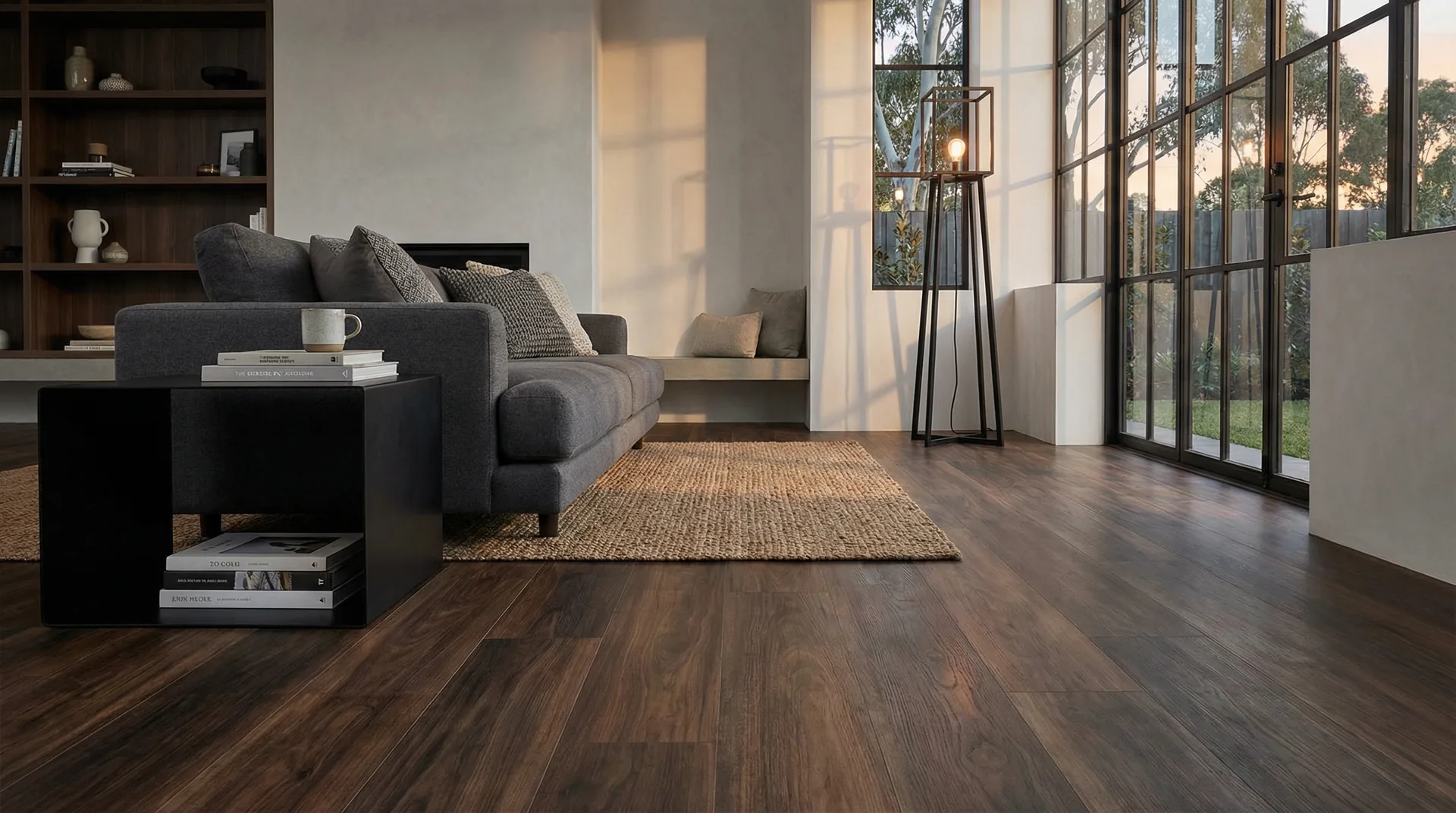
This is not the brown of the 1970s — not the heavy, saturated, golden-brown of pitch pine floorboards or the orange-amber of the polyurethane-finished boards that defined Australian homes of that era. The brown that defines 2026 is softer, more considered, and more sophisticated. Think warm mid-tones with grey undertones — the colours of driftwood, of turned earth after rain, of the inner bark of a river red gum.
These browns sit in a specific tonal range: light enough to retain brightness in a space, warm enough to create intimacy, and desaturated enough to feel contemporary rather than period. In hardwood flooring, this translates to reactive and smoke-fumed finishes on European Oak that bring out the wood's natural brown and grey tones simultaneously — a depth of colour that painted or stained finishes cannot replicate.
Smoked Oak: The Specification of the Year
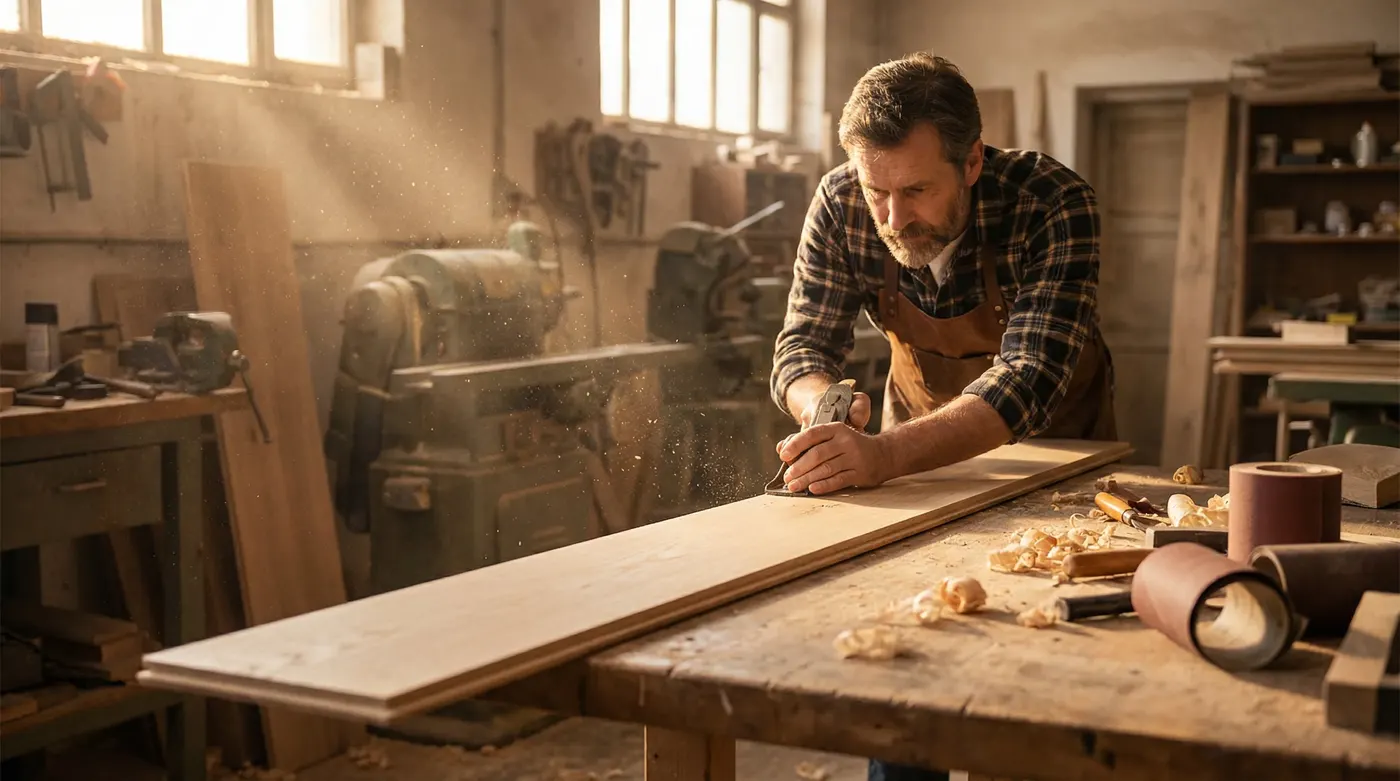
The smoke-fuming process involves exposing oak boards to ammonia vapour, which reacts with the tannins naturally present in the wood to produce a deep, warm grey-brown colour change that affects the full depth of the wood rather than just the surface. Unlike a pigmented stain that sits on top of the grain, reactive finishes become part of the timber itself — and they age with extraordinary grace, developing richer tones over time.
Smoked oak with a natural matte finish is, without qualification, the specification we are seeing specified most frequently in premium Melbourne residential projects in 2026. It pairs with virtually every contemporary cabinet colour — warm white, sage green, deep charcoal, and raw concrete equally — without competing.
Nature as the Design Reference
The movement driving this palette shift has a name: biophilic design. Rooted in the concept that human beings have an innate, neurologically grounded need to connect with natural environments, biophilic design principles hold that interior spaces should reflect, reference, and evoke the sensory qualities of nature — particularly in urban residential environments where daily contact with natural landscapes is limited.
Flooring is one of the most powerful tools in the biophilic designer's arsenal. A floor that reads as timber — or stone, or packed earth — creates an immediate psychological grounding effect that manufactured surfaces cannot replicate. This is why the move toward natural, muted, and organic tones in 2026 is not a stylistic whim. It is a response to a deeper, evidence-backed design philosophy.
The palette that biophilic design produces for flooring in 2026 includes:
Warm taupe: A greige tone with distinctly brown (not pink) warmth. Works universally across floor types — hardwood, hybrid, and carpet.
Oatmeal and raw linen: The off-white neutrals that feel natural rather than clinical. In carpet, these tones in wool loop constructions are among the most specified products in premium residential work this year.
Sage and olive: Soft, grey-inflected greens that reference the Australian bush palette. In carpet and upholstery, these tones are moving from accent to primary.
Whitewashed ash: In hardwood flooring, a lightly bleached or whitewashed finish on European Ash that retains the grain's natural warmth while lightening the overall tone. Ideal for beach-house and coastal-influenced interiors.
Hardwood Colour Trends in Detail
Reactive and Fumed Finishes
As described above, reactive finishes — whether through ammonia fuming or reactive tannin technology — are producing the most sought-after hardwood colours of 2026. The key characteristic that distinguishes these from conventional stains is authenticity: the colour variation that occurs naturally in a fumed board, where denser grain lines absorb the reaction differently to the surrounding wood, produces a floor with genuine depth and life. Something a conventionally stained timber cannot match.
Whitewashed Ash
European Ash has an open, prominent grain structure that responds beautifully to light pickling or whitewashing treatments. The result is a floor that reads as light and airy without being cold — the grain remains clearly visible and warm beneath the white layer. Whitewashed ash is particularly suited to coastal and relaxed Australian interiors, and to spaces with lower natural light levels where a pale floor is needed to reflect and amplify available light.
Australian Blackbutt
For clients who want a distinctly Australian aesthetic, a matte Blackbutt is a compelling 2026 specification. The matte finish leaves the timber surface feeling soft and natural underfoot, and the warm honey-blonde tones of Blackbutt pair exceptionally well with the earthy, biophilic palette surrounding it.
The Role of Light in Colour Selection
This is the consideration that is most frequently underestimated — and most frequently the source of disappointment when a floor that looked perfect in the showroom does not perform as expected in the home.
Natural light in Australia is different from the light assumed in most European flooring photography. It is brighter, more direct, and carries a stronger UV component. Morning light has a blue-white quality. Afternoon light in north-to-west-facing rooms carries a distinctly golden-amber tone. Southern-aspect rooms receive reflected light that is cool and consistent throughout the day.
Practical guidance by room orientation:
North-facing rooms (warm, consistent light): Almost any tone works. Warm browns and mid-tones sing in this light. Dark floors do not read as oppressive.
East-facing rooms (cool morning, dark afternoon): Prioritise lighter tones — oatmeal, whitewashed ash, pale taupe — to maintain brightness through the afternoon.
West-facing rooms (dark morning, intense warm afternoon): Avoid orange-toned timber floors, which can shift to visually overwhelming warmth in afternoon light. Cool-warm tones like smoked oak and driftwood grey perform best.
South-facing rooms (cool, consistent, no direct sun): Pale floors are critical. Dark floors in south-facing rooms will make the space feel notably smaller and heavier.
Warm Neutrals in Carpet
The carpet market in 2026 is experiencing precisely the same tonal shift as hardwood: away from cool grey loop piles and silver-tone cut piles, toward warm neutrals, earthy tones, and nature-inspired hues.
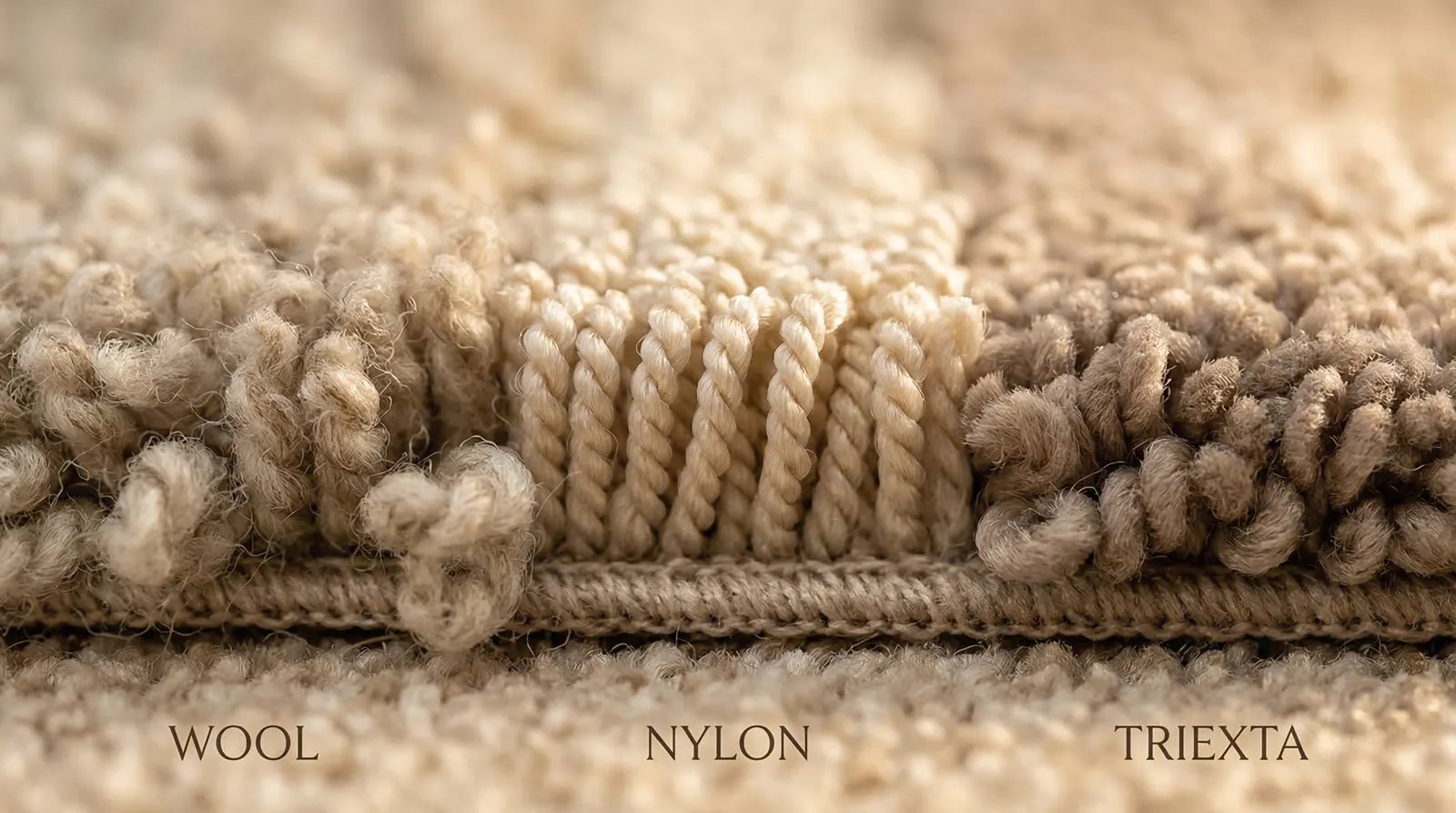
Wool loop piles in organic tones are the specification of the moment in premium bedrooms. A high-quality wool loop pile in warm oatmeal or soft taupe achieves something that no synthetic carpet can replicate: the natural variation of individual wool fibres creates a surface that reads differently at different angles and in different light, with a subtle depth that is inherently beautiful.
For living areas and family rooms, textured loop piles in warm mid-tone neutrals — tonal variations of greige, dune, and soft ochre — provide the durability for daily use whilst anchoring the biophilic palette.
Green tones in carpet — sage, olive, and eucalyptus — are moving from statement to mainstream. A sage wool loop pile in a bedroom creates a space that feels genuinely connected to the natural world in a way that is quiet, sophisticated, and deeply relaxing.
Pairing Floors with Cabinetry, Walls, and Furnishings
The most useful framework for pulling an interior together around a warm-toned floor is to think in terms of tonal family and contrast level, not matching.
With Warm Taupe or Oatmeal Floors
Cabinetry: Warm white, limewash, raw oak, or sage green. Avoid cool white — it will read as clinical against a warm floor.
Wall paint: Warm off-whites (avoid pure cool whites), limewash finishes in ochre or terracotta, deep charcoal for feature walls.
Soft furnishings: Linen, bouclé, and natural wovens in cream, rust, olive, and terracotta. Avoid synthetic-looking fabrics.
With Smoked Oak or Dark Warm-Brown Floors
Cabinetry: Natural timber in a complementary mid-tone, warm white, or deep charcoal. Avoid dark grey — too much visual weight.
Wall paint: Keep walls lighter to prevent the room from darkening. Warm white or a pale warm neutral.
Soft furnishings: Layer textures — a chunky natural fibre rug over the floor, linen cushions, leather or aged brass accents.
With Whitewashed Ash or Pale Floors
Cabinetry: Deep tones work beautifully here — charcoal, navy, or forest green provide contrast without conflict.
Wall paint: Almost unlimited flexibility. The pale floor reflects light effectively, meaning darker wall tones are workable without oppressing the space.
Soft furnishings: The pale floor is a neutral canvas. Any accent colour works. Richer tones — terracotta, rust, deep teal — look outstanding.
Styling by Room
Living rooms: The showpiece room deserves the statement floor. Wide-plank smoked oak or a warm-toned water resistant laminate in a large format is the dominant direction. Pair with a natural fibre rug to zone the seating area.
Kitchens: Durability first, beauty second. Warm-toned water-resistant laminate in taupe or driftwood grey provides the water resistance a kitchen demands whilst remaining contemporary.
Master bedrooms: This is where wool carpet earns its keep. A premium wool loop pile in warm oatmeal or sage is the luxury specification in a bedroom. The acoustic and thermal properties of wool combine with the colour to create a space that is genuinely restorative.
Home offices: Hardwood or quality water resistant laminate — carpet in a home office risks visible wear tracks at the desk chair, although carpet will perform well acoustically. A warm mid-tone in a low-sheen finish is professional without being corporate.
Children's rooms: Practical considerations dominate — easy cleaning, softness, and durability. A Triexta carpet in a warm neutral will outlast most childhoods and clean up remarkably well.
The Australian Perspective
Australian interior design in 2026 is not simply adopting European trends — it is synthesising them with the specific qualities of the Australian environment: the quality of our light, the texture of our native landscape, the materiality of our built environment. The warm earthy palette resonates here in a way that cool Nordic minimalism never fully did, because it references the colours we actually see when we look out the window — red earth, pale bark, bleached grass, grey-green eucalyptus.
When the floor beneath your feet tells the same story as the landscape outside, something in the room feels resolved. That is the design principle worth holding onto as you make your flooring decision for 2026.
Published by The Flooring Centre — Melbourne's premium carpet and flooring superstores. Visit our Nunawading and Hawthorn showrooms.