| SPC (Solid Polymer Core) | EPC (Expanded Polymer Core) | |
|---|---|---|
| Core structure | Solid, no air pockets | Aerated, cellular structure |
| Limestone content | Higher (~60–70%) | Moderate (~40–50%) |
| PVC/plasticiser content | Lower (~25–35%) | Higher (~40–50%) |
| Density | Higher — heavier per m² | Lower — lighter per m² |
| Indentation resistance | Superior | Moderate |
| Comfort underfoot | Firmer | Softer, warmer |
| Acoustics | Adequate (improved with underlayment) | Naturally quieter |
| Dimensional stability | Very good | Good |
| Ideal for | High-traffic areas, commercial, underfloor heating | Bedrooms, living areas, upper storeys |
By The Flooring Centre — Industry Technical Perspective
If you've started researching flooring, you've probably run into a wall of acronyms — SPC, EPC, LVT, LVP — and walked away more confused than when you started. You're not alone. The flooring industry hasn't done itself any favours with naming conventions, and a lot of the information online is outdated or flat-out wrong.
So let's cut through it.
Hybrid flooring and vinyl flooring are closely related. They share many of the same raw ingredients. The difference comes down to how those ingredients are combined — specifically, the ratio of mineral filler to polymer, the amount of plasticiser in the mix, and whether the core is solid or aerated. Those distinctions change everything about how the floor performs underfoot.
This article is designed to give you the full picture — the good, the not-so-good, and the things most retailers won't mention. If you're going to invest in flooring, you deserve to know what you're actually buying.
A Brief History: How We Got Here
To understand the hybrid flooring category, it helps to know where it came from — because the evolution explains why the terminology is so confused today.
The Vinyl Foundation
Vinyl flooring has been around since the mid-twentieth century. In its simplest form, it's a flexible sheet or tile made primarily from PVC resin, plasticisers and mineral fillers. For decades, this was the formula: a pliable, water-resistant, affordable floor covering that could be printed to look like almost anything. Luxury Vinyl Tile (LVT) and Luxury Vinyl Plank (LVP) refined this concept with better printing, thicker wear layers and more realistic textures — but the core remained essentially the same. Flexible PVC, heavy on the plasticiser.
The First Rigid Cores: WPC
Around 2012, manufacturers began experimenting with a different approach. Instead of a flexible vinyl core, they created a rigid composite board using PVC, calcium carbonate (limestone) and a foaming agent, then laminated a vinyl surface layer on top. This was originally called WPC — Wood Plastic Composite — because early formulations included wood flour in the core mix.
It was a genuine breakthrough. The rigid, foamed core meant the product could click-lock together and float over the subfloor like a laminate, hide minor subfloor imperfections, and deliver strong moisture resistance. It was vinyl's durability married with the installation practicality of a hard-surface floor — and it sold in enormous volumes.
But WPC had problems. The foamed core was soft and prone to denting. The high PVC content made it reactive to temperature changes. And as the Australian market would later discover, those early formulations were vulnerable to chemical attack from concrete subfloors — something that wasn't fully understood at the time.
The Solid Core Arrives: SPC
By the mid-2010s, manufacturers had taken the concept further. They stripped out the foaming agent and dramatically increased the limestone content, creating a dense, solid core with no air pockets. This produced a thinner, heavier, more rigid plank that resisted indentation far better than its foamed predecessor. The industry initially called it "Stone Plastic Composite," but that name described one formulation, not the category.
In December 2017, the Multilayer Flooring Association (MFA) formalised the terminology. SPC was officially defined as Solid Polymer Core — any rigid vinyl flooring with a non-foamed core. The "S" stands for Solid, not Stone.
EPC: The Aerated Alternative
With SPC dominating the market, there was still demand for the comfort and acoustic properties of the original foamed-core products — but with better performance and modern manufacturing. The result was EPC: Expanded Polymer Core. This is essentially the evolution of those early WPC products, using refined formulations (often without wood flour) and improved foaming processes to create a controlled, aerated cellular structure within a rigid core.
So the timeline looks like this:
Flexible vinyl (LVT/LVP) → WPC (foamed rigid core, early generation) → SPC (solid rigid core) → EPC (refined aerated rigid core)
In Australia, both SPC and EPC products are commonly referred to as hybrid flooring — and that's the term you'll see in most showrooms today.
The Core Ingredients
Before we separate hybrid from vinyl, it helps to understand that they're built from the same family of materials:
- PVC resin (polyvinyl chloride) — the polymer that acts as the binder holding everything together
- Calcium carbonate (limestone) — a natural mineral filler that adds density, rigidity and dimensional stability
- Plasticisers — additives that control how flexible or rigid the final product is
- Stabilisers — compounds that protect the product from heat and UV degradation over time
- Processing aids — small amounts of lubricants, impact modifiers and pigments used during manufacturing
Every product in this category — whether it's a flexible vinyl plank or a rigid hybrid plank — uses some combination of these ingredients. The recipe is what sets them apart.
The Role of Plasticisers
Plasticisers are arguably the most important variable in the formulation, yet they're rarely discussed in consumer-facing information.
PVC in its raw state is a rigid, brittle material. On its own, it would crack and shatter. Plasticisers are chemical additives blended into the PVC that sit between the polymer chains and allow them to slide past each other — making the material soft, pliable and workable. The more plasticiser you add, the more flexible the end product becomes.
This is the single biggest difference between traditional vinyl flooring and hybrid flooring.
Traditional LVT/LVP uses a relatively high proportion of plasticiser in its core. This is what gives the plank its characteristic flexibility — you can bend it, roll it, and it will conform to the surface beneath it. That flexibility is an advantage for glue-down installations, but it also means the product is more susceptible to expansion and contraction with temperature changes, and more prone to telegraphing subfloor imperfections.
Hybrid flooring (SPC and EPC) uses significantly less plasticiser. In SPC products, the plasticiser content is minimal — the high limestone content and low plasticiser ratio produce a core that is dense and rigid. In EPC products, there is moderately more plasticiser than in SPC (contributing to the softer feel), but still far less than in traditional flexible vinyl.
A Brief History of Phthalates in Flooring
For most of vinyl flooring's history, the plasticisers used were phthalates — a family of chemical compounds derived from phthalic acid. The most common was DEHP (di-2-ethylhexyl phthalate), which became the workhorse plasticiser of the PVC industry from the 1950s onwards. In flooring specifically, BBP (benzyl butyl phthalate) was considered the gold standard for many years due to the finish and workability it provided.
DEHP and BBP belong to a group known as low molecular weight (LMW) phthalates. These are smaller molecules with shorter carbon backbones (typically 3–6 carbon atoms in the alkyl chain). Their smaller size is what made them effective plasticisers, but it's also what makes them problematic: LMW phthalates are more volatile, more prone to migrating out of the PVC matrix over time, and more easily released into the surrounding environment through off-gassing or physical contact.
Research over several decades linked LMW phthalates — particularly DEHP, DBP (dibutyl phthalate) and BBP — to endocrine disruption, meaning they can interfere with hormone function. This led to regulatory action: the European Union restricted DEHP, DBP and BBP in flexible PVC products in 2015, and similar measures followed in other markets.
As the industry moved away from LMW phthalates, the first replacement was DINP (diisononyl phthalate) — a high molecular weight (HMW) phthalate. HMW phthalates have longer carbon chains (7+ carbon atoms), which means the molecules are larger, less volatile, and far less likely to migrate out of the finished product. Around 95% of DINP production goes into flexible PVC applications, and it became the mainstream plasticiser in flooring through the late 2010s. The health profile of DINP is considered significantly more favourable than its LMW predecessors — the larger molecules stay embedded in the PVC matrix rather than off-gassing into the room.
More recently, the industry has shifted further toward non-phthalate plasticisers altogether. The most common is DOTP (dioctyl terephthalate). Despite the similar-sounding name, DOTP is a terephthalate, not a phthalate — it has a fundamentally different chemical structure. DOTP offers lower volatility, reduced migration, and is approved for use in sensitive applications including medical devices and children's toys. Another non-phthalate alternative is DINCH, which was specifically developed for applications where human contact is prolonged.
By around 2019, most major flooring manufacturers had largely completed the transition away from phthalate-based plasticisers. Quality hybrid and vinyl products today typically use DOTP or similar non-phthalate alternatives, paired with calcium-zinc stabilisers (replacing older lead and tin-based systems).
Why This Matters for Hybrid vs Vinyl
The relevance to this article is straightforward: vinyl flooring uses significantly more plasticiser than hybrid flooring. A traditional LVT/LVP product has a higher proportion of plasticiser in its overall composition because that's what creates the flexibility. Hybrid flooring — particularly SPC — has minimal plasticiser content because the rigidity comes from limestone, not from polymer flexibility.
This doesn't mean vinyl flooring is unsafe. Modern formulations using DOTP and DINCH are well-tested and widely approved. But it does mean that if plasticiser content is a consideration for you — whether for health, environmental or performance reasons — it's worth understanding that not all floors in this family contain the same amount.
What Is Hybrid Flooring?
In Australia, "hybrid" is the common name for rigid-core vinyl flooring. It earned the name because it combines the realistic visuals of vinyl with the structural rigidity of a hard-surface floor — a hybrid of two worlds.
Hybrid flooring comes in two core types: SPC and EPC.
SPC — Solid Polymer Core
SPC is defined by its dense, non-foamed core. The MFA formally defines SPC as a rigid vinyl flooring product with a solid polymer core — meaning no intentional cellular structure or air pockets within the core layer.
Typical SPC core composition:
- ~60–70% calcium carbonate (limestone)
- ~25–35% PVC resin
- ~4–5% stabilisers, processing aids and pigments
- Minimal plasticiser
That high mineral content is what gives SPC its characteristic density and weight. The core is extruded under heat and pressure into a solid, dense board with very low porosity. Because there are no foaming agents and no air introduced into the mix, the result is an exceptionally rigid and dimensionally stable plank.
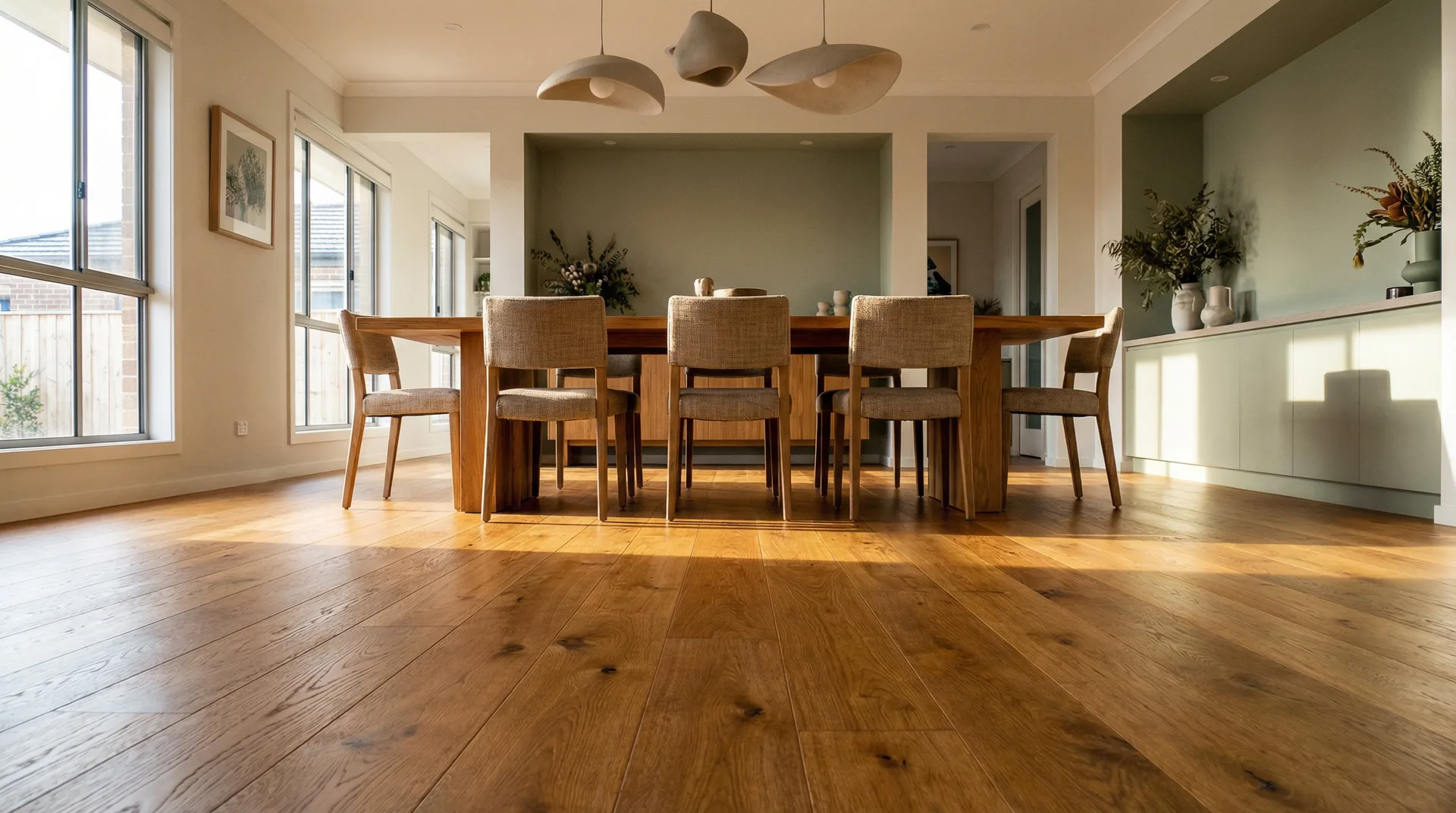
What that means in practice:
- Outstanding indentation resistance — heavy furniture and high heels are far less likely to leave permanent marks
- Better dimensional stability with temperature changes than traditional vinyl, making it more suitable for underfloor heating and larger installations
- A thinner overall plank profile (typically 4–6mm plus underlayment) while still delivering solid structural performance
- A firmer feel underfoot — SPC trades some cushion for its stability and dent resistance
EPC — Expanded Polymer Core
EPC uses the same base ingredients as SPC — PVC resin, calcium carbonate, stabilisers — but with one critical addition: a foaming agent. During manufacturing, the core mixture is heated and pressed in a way that causes the foaming agent to create a controlled cellular structure within the core. The polymer literally expands, introducing microscopic air pockets throughout the board.
Typical EPC core composition:
- ~40–50% calcium carbonate
- ~40–50% PVC resin and plasticisers
- Foaming agents, stabilisers and processing aids
The roughly equal ratio of mineral filler to polymer (compared to SPC's limestone-heavy mix), the higher plasticiser content, and the aerated cellular structure together produce a core that is lighter, more resilient and acoustically superior.
What that means in practice:
- A softer, warmer feel underfoot — the air within the cellular structure provides natural cushioning
- Better sound absorption — EPC floors are noticeably quieter, both in-room and for transmission to rooms below
- A slightly thicker plank profile, which contributes to comfort and sound performance
- Lighter weight per square metre than SPC
- Lower indentation resistance compared to SPC — the aerated structure compresses more easily under sustained point loads
- Higher PVC and plasticiser content than SPC, which is worth considering from both a performance and a health perspective
SPC vs EPC — The Key Trade-Off
They're engineered for different priorities:
Both use click-lock installation. Both float over the subfloor. The choice comes down to whether you prioritise impact resistance and stability (SPC) or comfort and acoustics (EPC).
The "Waterproof" Question
This is where the conversation gets important — and where a lot of the marketing around hybrid flooring has been misleading.
Hybrid flooring has been sold for years as a "100% waterproof" product. And on the surface, that claim has merit: if you spill water on top of a hybrid plank, it won't absorb it. The surface is non-porous, the click-lock joints are tight, and liquid sits on top until you wipe it up. In that sense, yes — hybrid handles surface moisture well.
But "waterproof" implies something more than just surface resistance. It implies the product is immune to water-related damage. And independent testing has shown that's not the full story.
What the ATFA Found
The Australian Timber Flooring Association (ATFA), in collaboration with Griffith University and leading importers, conducted comprehensive independent testing on 22 hybrid flooring products from seven major suppliers in the Australian and New Zealand markets.
The results confirmed that hybrid flooring doesn't absorb high levels of moisture overall — that part of the marketing holds up. But the testing also revealed unresolved questions about permeability from below.
Some boards had what researchers described as a "loose" core structure, where the calcium carbonate particles weren't fully encapsulated by the polymer matrix. In these products, moisture vapour — particularly alkaline moisture rising from concrete subfloors — could penetrate the board through voids and micro-gaps in the core.
Alkalinity Hydrolysis: The Hidden Risk
When moisture with a high alkaline content (typically pH 11–13, which is normal for a recently poured or inadequately cured concrete slab) reaches the core of a hybrid plank, it triggers a slow chemical reaction called alkalinity hydrolysis.
Here's what happens: the alkaline moisture reacts with the PVC polymer and the ester bonds in the plasticisers within the board. This reaction gradually breaks down the polymer chains, weakening the structural integrity of the core. The damage typically starts at the locking system — the joins where boards click together — because that's where the core is thinnest and most exposed.
The consequences include:
- Loss of rigidity — the core softens, and the plank loses its structural integrity
- Cupping and edge curl — boards begin to dish or lift at the edges
- Joint failure — the click-lock system weakens and planks separate
- Mould and mildew — as the core degrades, micro-cracks create pockets where moisture lingers, providing an environment for fungal growth
The damage is irreversible. Once alkalinity hydrolysis has broken down the polymer in the core, the board cannot be repaired, sanded or restored. The only remedy is full replacement.
The ATFA testing found that products with larger, poorly encapsulated calcium carbonate particles and higher PVC content were the most susceptible. Denser SPC products with finely ground limestone and tight polymer encapsulation fared significantly better — but no product tested was completely immune when exposed to high-alkaline conditions without a moisture barrier.
What This Means in Practice
This doesn't mean hybrid flooring is a bad product. It means the "waterproof" label needs context.
Hybrid flooring resists surface water very well. But it is not immune to chemical attack from below — specifically, the alkaline moisture vapour that naturally rises from concrete subfloors. This is a critical distinction, because the vast majority of Australian homes are built on concrete slabs.
The fix is simple and inexpensive: a minimum 150-micron polyethylene sheet (builder's plastic) laid over the concrete before installation acts as a barrier against alkaline moisture. The ATFA recommends this as standard practice for every concrete subfloor installation — and reputable installers have always done it.
The broader point is worth keeping in mind: no floor is truly waterproof. Every flooring product has conditions under which moisture can cause damage. The question is how much preparation and precaution is needed, and how transparent the industry is about those requirements.
What Is Vinyl Flooring (LVT/LVP)?
LVT (Luxury Vinyl Tile) and LVP (Luxury Vinyl Plank) refer to the traditional, flexible form of vinyl flooring. These are the products that started the vinyl revolution — and they're still widely used today, particularly in commercial fit-outs and glue-down applications.
LVT and LVP use the same core ingredients as hybrid flooring — PVC resin, calcium carbonate, plasticisers and stabilisers — but in very different proportions.
Typical LVT/LVP composition:
- PVC resin makes up the dominant share of the product
- Plasticiser content is significantly higher than in hybrid products, giving the plank its characteristic flexibility
- Calcium carbonate is present as a filler, but at a much lower concentration than in SPC or EPC
- The overall product is thinner (typically 2–5mm) and pliable enough to conform to the subfloor beneath it
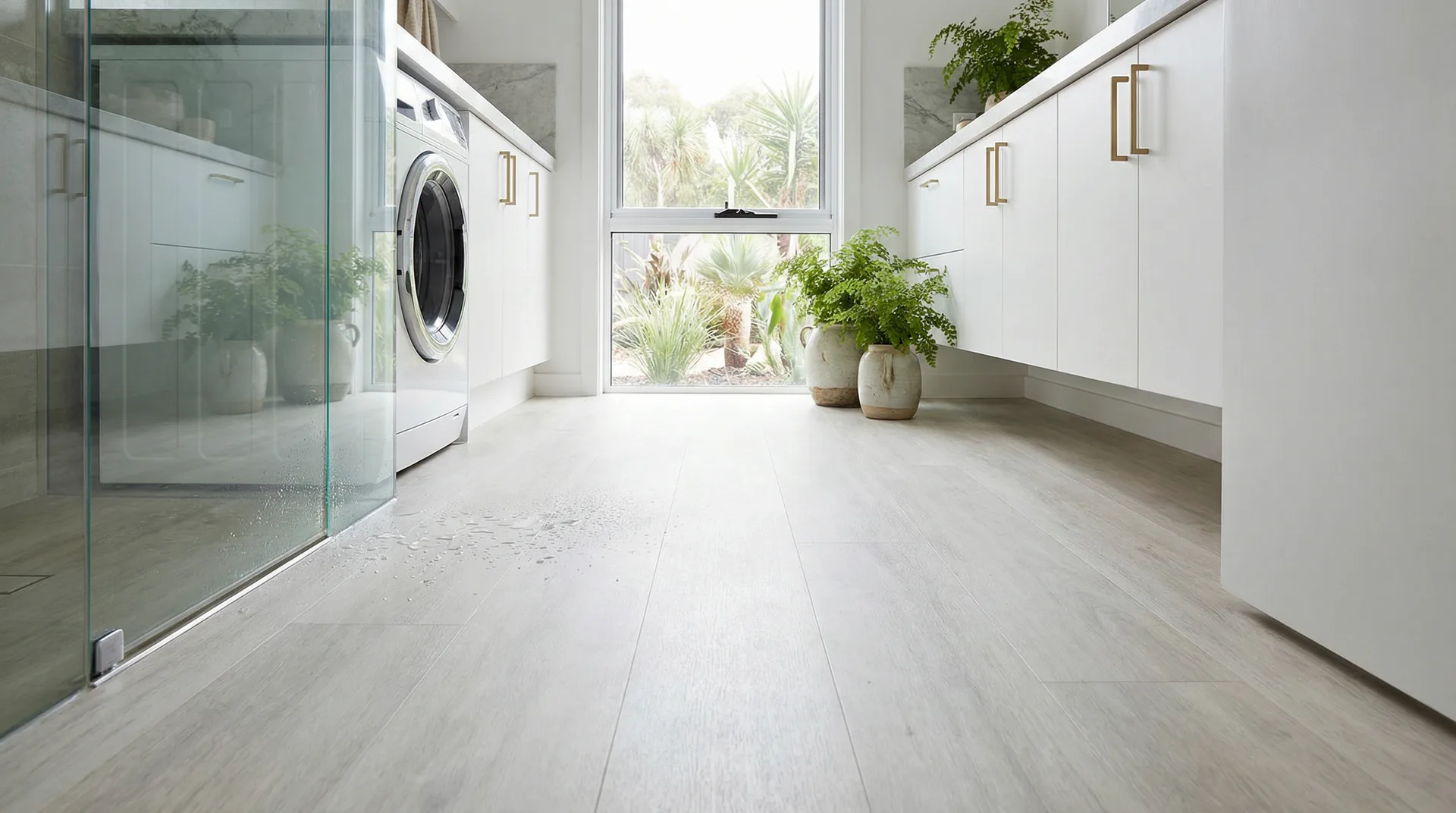
Because traditional LVT/LVP has a flexible PVC core rather than a rigid composite core, it behaves quite differently:
- LVT/LVP is thinner and lighter, making it a practical choice for renovations where floor height is constrained
- It requires a smoother, flatter subfloor — because the product is flexible, imperfections in the surface below will telegraph through and become visible over time
- It is typically installed using adhesive (glue-down), though some newer LVP products offer loose-lay or click-lock options
- It has less inherent structural rigidity, so it can expand and contract more noticeably with temperature changes
- Indentation resistance is lower than SPC hybrid, as there's no dense mineral-loaded core absorbing the impact
LVT and LVP remain practical products in the right application. Commercial environments with controlled climates, multi-level retail, healthcare, hospitality and education facilities all benefit from glue-down LVT's low profile, acoustic performance (when paired with appropriate adhesives and underlayments) and design versatility.
The Honest Trade-Offs
Here's the part most hybrid and vinyl articles skip — the limitations that don't make it into the marketing material.
Scratch and Dent Resistance
Hybrid and vinyl flooring surfaces are made from PVC-based wear layers. PVC is inherently softer than materials like melamine or aluminium oxide (the resins used on laminate flooring surfaces). This means hybrid and vinyl floors are more susceptible to scratching from pets, furniture legs, grit tracked in on shoes, and general daily wear. Heavy or sharp furniture legs can also leave indentation marks — particularly on EPC and vinyl products where the core provides less resistance.
This is a trade-off worth understanding. If you have large dogs, active children, or heavy furniture that gets moved regularly, the wear layer on a hybrid or vinyl floor will show it over time.
UV and Heat Sensitivity
PVC-based products are reactive to ultraviolet light and temperature changes. Despite UV stabilisers in the formulation, prolonged direct sunlight can cause colour fading and, in some cases, discolouration or yellowing of the wear layer over time. This is particularly relevant in Australian homes with large north- or west-facing windows.
Temperature changes also cause expansion and contraction. The ATFA testing measured consistent movement of approximately 0.5mm per metre for every 10°C shift in temperature. Over a typical Australian seasonal range (say 5°C in winter to 35°C in summer), that translates to roughly 1.25mm of movement per metre. In a 12-metre span, you're looking at up to 15mm of total movement — enough to cause buckling, joint separation or pressure build-up if expansion gaps and compartmentalisation trims aren't properly managed.
The ATFA recommends a maximum raft size of 12m × 12m, with compartmentalisation trims in complex layouts.
Flame Resistance
PVC is not a naturally fire-resistant material. While hybrid and vinyl products are self-extinguishing (they won't sustain a flame once the heat source is removed), they will melt, deform and produce smoke when exposed to heat. A dropped cigarette, a hot pan placed on the floor, or a stray ember from a fireplace can cause localised damage that cannot be repaired. This is an area where other flooring categories — particularly modern laminates with melamine surfaces — perform measurably better.
Environmental Considerations
PVC is a petroleum-derived plastic. The manufacturing process for vinyl and hybrid flooring involves energy-intensive extrusion, and the products are difficult to recycle at end of life because the PVC, limestone and plasticiser components are fused together. Most hybrid and vinyl flooring ends up in landfill.
From a lifecycle perspective, this is worth weighing against other flooring options that use wood-based or more readily recyclable core materials. It doesn't make hybrid or vinyl bad choices — but if environmental impact is part of your decision-making process, it's a factor.
The Full Picture: Same Ingredients, Different Ratios
Here's the part most explanations get wrong, or at least oversimplify: hybrid and vinyl flooring are not made from fundamentally different materials. They share the same building blocks. The distinction is in the formulation — primarily the ratio of limestone to PVC, the amount of plasticiser, and whether a foaming agent is introduced.
| Traditional LVT/LVP | EPC Hybrid | SPC Hybrid | |
|---|---|---|---|
| PVC resin | Dominant component | ~40–50% | ~25–35% |
| Calcium carbonate | Moderate filler | ~40–50% | ~60–70% |
| Plasticiser | High (creates flexibility) | Moderate | Low |
| Foaming agent | None | Yes (creates aerated core) | None |
| Core character | Flexible | Rigid, aerated | Rigid, solid |
| Density | Low–moderate | Moderate | High |
As the calcium carbonate ratio increases and the plasticiser decreases, the product becomes more rigid, more dimensionally stable and more resistant to indentation. Introduce a foaming agent to the mid-range formulation and you get EPC — a rigid product with built-in cushion and acoustic performance. Remove the foaming agent and push the limestone content higher still and you get SPC — the densest, most impact-resistant option in the family.
It's a spectrum, not a binary choice.
A Note on Terminology
The flooring industry is full of overlapping and sometimes misleading acronyms. Here's what the formal definitions actually mean:
- SPC = Solid Polymer Core. Defined by the MFA as a rigid vinyl flooring product with a solid (non-foamed) polymer core. You may see it referred to elsewhere as "Stone Plastic Composite" — this is an older, informal term from the mid-2010s that described one specific formulation rather than the broader category. The formal industry definition is Solid Polymer Core.
- EPC = Expanded Polymer Core. A rigid vinyl flooring product with an intentionally foamed or aerated polymer core. This is the modern, accurate term for products that were previously grouped under the WPC (Wood Plastic Composite) umbrella — a name that became misleading as manufacturers moved away from using wood flour in their formulations.
- LVT = Luxury Vinyl Tile. Traditional flexible vinyl flooring in a tile format.
- LVP = Luxury Vinyl Plank. Traditional flexible vinyl flooring in a plank format.
- Hybrid. The Australian market term for rigid-core vinyl flooring (whether SPC or EPC). Not an official industry acronym, but universally understood in this market.
Which One Is Right for You?
There's no single best answer — only the best answer for your space, your lifestyle and your priorities. And that answer might not be hybrid or vinyl at all.
SPC hybrid is a solid option if you need a rigid, stable plank for areas with underfloor heating, large open-plan spaces, or commercial fit-outs where the subfloor is properly prepared with an appropriate moisture barrier.
EPC hybrid suits situations where comfort and acoustics are priorities — bedrooms, living rooms, upper-storey apartments — though the higher PVC and plasticiser content and lower indentation resistance are worth factoring in.
LVT/LVP remains practical for commercial glue-down applications where floor height is constrained and the subfloor conditions are well controlled.
But if scratch resistance, flame resistance, dent resistance, UV stability, health (lower chemical content), and long-term environmental impact are important to you, it's worth looking beyond the hybrid and vinyl category altogether. Modern water-resistant laminates, for example, have evolved significantly — offering superior performance in many of these areas while addressing the water sensitivity that was once laminate's Achilles' heel.
The best way to understand the difference is to feel it. Visit a showroom, pick up a plank of each, and you'll immediately notice the weight, the rigidity and the feel. Ask questions about what's inside the product, not just what's printed on the surface. The specs tell part of the story — your hands tell the rest.
Published by The Flooring Centre — Melbourne's premium carpet and flooring superstores. Visit our Nunawading and Hawthorn showrooms.