| ACCS Rating | Use Category | Typical Application |
|---|---|---|
| 1 Star | Light Residential | Light-duty bedroom, study |
| 2 Star | Medium Residential | Living area, medium-duty zones |
| 3–4 Star | Heavy Residential | Hallways, family rooms, high-traffic areas |
| 5–6 Star | Extra Heavy Residential | Stairs (minimum 3 star required), heavy-use common areas |
By The Flooring Centre Technical Team — Technical Expert Perspective
Carpet selection in the Australian market is too frequently reduced to a decision about colour and price. This is understandable — carpet showrooms present an overwhelming array of visual options, and the fibre technology behind the surface is rarely visible to the eye. But the fibre composition of a carpet is the single most important determinant of how it will perform over time: how it responds to foot traffic, how it behaves under staining, how it ages in our specific climate conditions, and how it will look in five, ten, or fifteen years' time.
This guide provides a rigorous examination of the four primary fibre types available in the Australian residential market — Triexta, Solution Dyed Nylon, Wool, and Polyester/PET — with the technical depth necessary to make an informed, long-term decision.
The Australian Carpet Classification Scheme (ACCS)
Before examining individual fibre types, it is worth understanding the framework within which carpet performance is objectively measured in Australia.
The Australian Carpet Classification Scheme (ACCS), administered by the Carpet Institute of Australia Limited (CIAL), provides a standardised star rating from 1 to 6 that reflects a carpet's appearance retention properties — that is, how well the carpet maintains its visual integrity under use over time. The rating is not simply a marketing claim; it is derived from a structured testing protocol that combines objective performance metrics (accounting for 90 out of 100 points) with a calibrated subjective assessment (10 out of 100 points).
The ratings map to use-case categories:
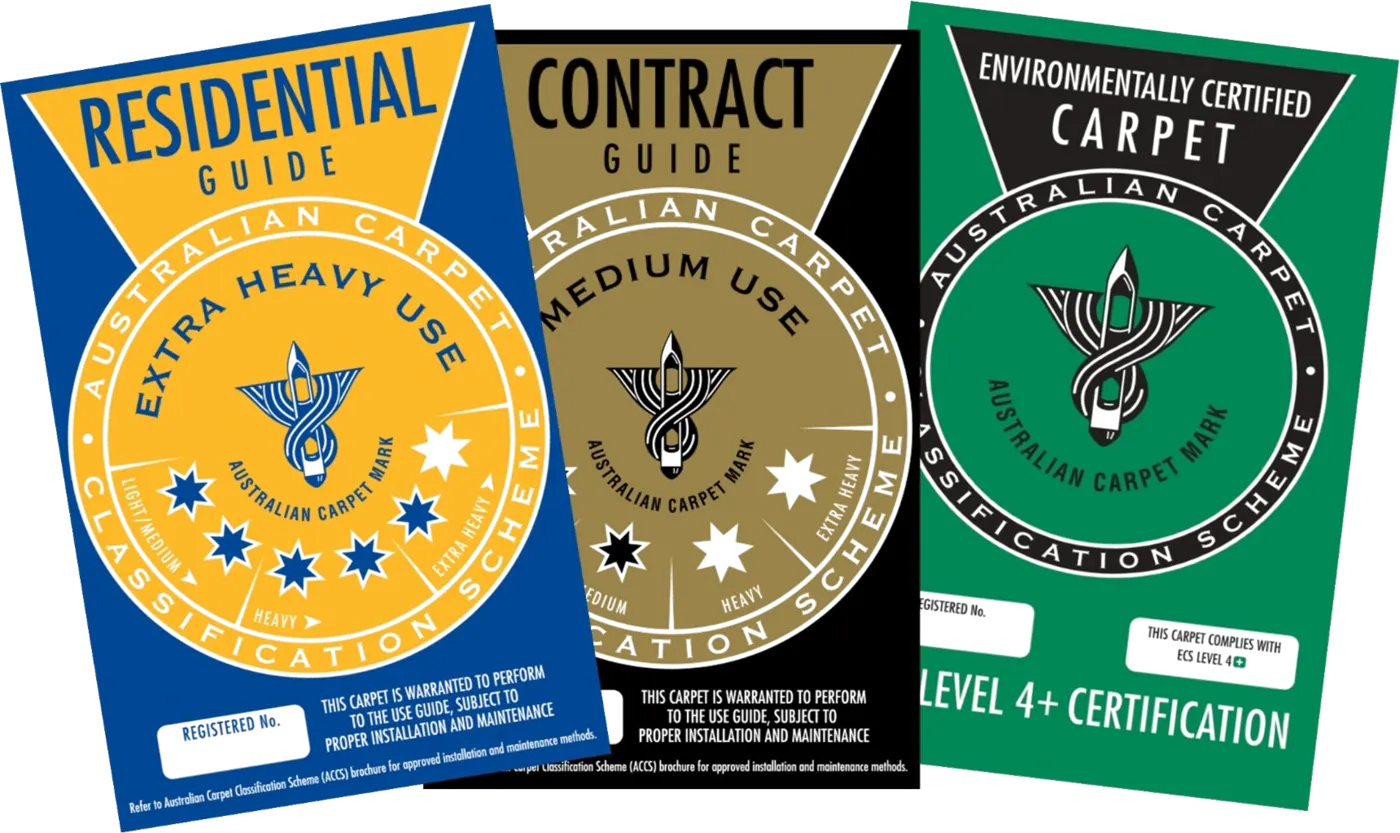
The ACCS also incorporates an Environmental Certification Scheme, assessing carpets for VOC (volatile organic compound) emissions, acoustic noise reduction performance, and thermal insulation contribution. When specifying carpet for spaces where indoor air quality is a consideration — bedrooms, children's rooms, healthcare-adjacent environments — ACCS Environmental Certification provides a meaningful benchmark.
Always match your carpet's ACCS rating to the actual use demands of the space. Under-specifying is the most common cause of premature carpet failure.
Fibre Type 1: Triexta — Permanent Stain Resistance Explained
Triexta is a relative newcomer to the carpet fibre category, and it has been met with both enthusiasm and confusion since its commercial introduction. The confusion largely stems from a genuine chemical misunderstanding that has been compounded by imprecise marketing — and it is worth addressing this directly before examining the fibre's properties.
Is Triexta Just Polyester? No — and the Chemistry Matters
Both Triexta and Polyester belong to the broader polyester family of polymers, but at the molecular level they are distinct materials with meaningfully different performance profiles. Triexta is technically classified as poly(trimethylene terephthalate), or PTT — a polytrimethylene terephthalate polymer — compared to the poly(ethylene terephthalate), or PET, used in standard polyester carpet. The difference in the polymer backbone — three-carbon versus two-carbon chain repeating units — produces a fibre with significantly different physical characteristics.
PTT's molecular structure gives Triexta a pronounced helical (spring-like) configuration at the fibre level. This translates to real-world resilience: Triexta fibres compress under foot traffic and recover their original shape more effectively than PET polyester. In a pile carpet, this means better long-term pile height retention and reduced pile crush — one of the primary visual failure modes in residential carpet.
Permanent Stain Resistance: How It Works
Triexta's most commercially significant property is its inherent, permanent stain resistance — and understanding why this is "permanent" requires understanding what stain resistance actually means at the fibre level.
In conventional nylon carpet, stain resistance is achieved through a topical treatment: a fluorochemical or stain-blocker compound is applied to the fibre surface during finishing. This treatment degrades over time with cleaning, foot traffic, and UV exposure. Within several years of use, the stain protection of a treated nylon carpet has typically declined significantly.
Triexta's stain resistance operates on a different mechanism entirely. PTT is hydrophobic by nature — the polymer backbone repels water-based compounds at a molecular level, without any topical treatment. This hydrophobic character is an intrinsic property of the fibre, not a surface application, and it does not degrade with cleaning or age. The result is a carpet that resists liquid-based staining — including pet accidents, food and beverage spills, and even red wine — without any treatment that can be washed away.
The important caveat: Triexta's inherent resistance applies to water-based stains. Oil-based stains — cooking oils, greasy food residue, some cosmetics — require prompt treatment and are not resisted with the same reliability. For households where oil contamination is a realistic concern (open-plan kitchen-living areas, for example), this should factor into specification.
Triexta in the Australian Climate
Triexta's PTT structure has a low moisture absorption rate, which gives it excellent performance in humid environments. For coastal properties or Queensland-influenced climates where seasonal humidity is elevated, Triexta maintains its pile structure and resists the musty odour development that can affect natural fibres in persistently damp conditions.
Fibre Type 2: Solution Dyed Nylon — Commercial Grade Performance for Residential Spaces
Nylon has been the benchmark commercial flooring fibre for decades, and Solution Dyed Nylon (SDN) represents the highest expression of nylon performance for demanding residential and commercial applications.
The Solution Dyeing Difference
Standard nylon carpet is manufactured as an undyed fibre and subsequently dyed during the finishing process — colour is added to the surface and structure of the fibre after extrusion. Solution dyed nylon reverses this process: the colorant pigment is added to the liquid polymer melt before the fibre is extruded. The colour is not applied to the fibre — it is the fibre. Throughout the entire cross-section of every individual filament, the colour is molecularly integrated.
The practical implications of this are significant:
Colourfastness: Because the pigment is encapsulated within the polymer matrix rather than absorbed onto its surface, it is not accessible to the fading mechanisms that affect conventionally dyed carpet — UV radiation, chlorine from cleaning products, bleach spills. SDN carpet is effectively bleach-resistant* and exhibits outstanding UV fade resistance. For rooms with high sun exposure, a critical consideration in Australian conditions, SDN is the superior specification. (*Bleach is not recommended to be used on any carpet due to issues it can create with other aspects of the carpet, namely the degrading of the latex used to hold the primary and secondary layers of backing together, so always consult with your specific manufacturer's guidelines before using bleach!)
Stain visibility: Solution dyeing saturates the fibre so completely that staining agents have no undyed fibre to bond with. Liquid stains that would permanently discolour a conventionally dyed fibre are simply unable to alter the pre-existing colour of an SDN fibre.
Nylon's Structural Advantages
Beyond solution dyeing, nylon's fundamental polymer chemistry gives it a fatigue resistance that no other synthetic fibre matches. Nylon fibres flex repeatedly under compression without the progressive molecular degradation that causes polyester fibres to lose resilience over time. In high-traffic areas — stairs, hallways, family rooms — a 5–6 star ACCS-rated SDN carpet will retain its appearance and pile structure for significantly longer than equivalent-weight polyester alternatives.
Nylon also accepts both acid dye and cationic dye processes (in the case of conventionally dyed products), enabling a very wide colour palette and sophisticated multi-tone effects that can be difficult to achieve in solution-dyed products where the colour range is determined during manufacturing.
Fibre Type 3: Wool — The Natural Standard
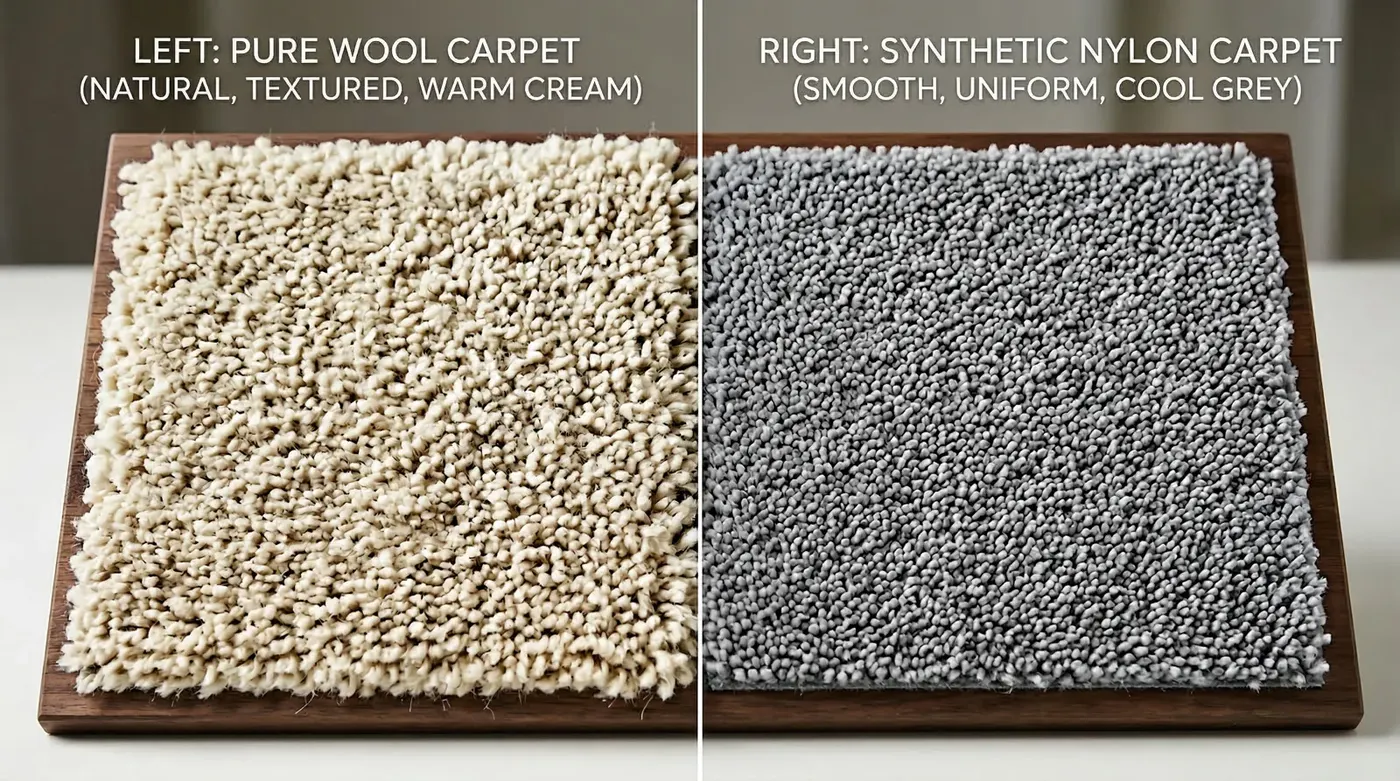
Wool holds a unique position in the carpet fibre hierarchy. It is the only major carpet fibre that is both natural and renewable, and its performance profile — particularly in the context of indoor air quality and thermal management — remains unmatched by any synthetic alternative.
Fibre Structure and Performance
Wool fibre has a complex hierarchical structure that underpins its performance characteristics. At the macro level, the natural crimp in wool fibres provides an inherent spring that supports pile recovery under compression. At the microscopic level, the cuticle scale structure of the fibre surface gives wool excellent soil-concealment properties — fine particulate soil (the primary soiling agent in residential carpet) is captured between fibre scales and held away from the base of the pile, where it would be most visible, until vacuuming removes it.
Wool's protein-based chemistry (keratin) gives it a natural flame retardance that no synthetic fibre intrinsically possesses. Wool does not support combustion — it chars rather than melts, extinguishes itself when the ignition source is removed, and does not produce the toxic molten drip associated with burning synthetic fibres. In bedroom applications, this fire retardance property has genuine safety relevance.
New Zealand Wool vs Blends
New Zealand Wool — Romney and Perendale are amongst the breeds of sheep used to produce outstanding wool for carpet production from New Zealand's pastoral farming industry. Wool carpet yarn from New Zealand is regarded as the international quality benchmark for carpet wool. Its fibre characteristics (diameter, staple length, softness, resilience) are highly consistent due to New Zealand's specialised breeding programmes and favourable pastoral conditions. A pure NZ Wool carpet represents the premium specification within the wool category.
Woolmark Wool — formerly known as the International Wool Secretariat (IWS) is a brand of wool that is sourced from various participating countries and is generally associated with non-carpet use, such as garments and other fabric-based products.
European Blends — Higher micron fibres from appropriate breeds can sometimes be used in European made wool carpet such as Scottish Blackface, Herdwick and Swaledale, however as a general observation, they will not be as "pure" in appearance as New Zealand wool, so tend to be not as favoured in many domestic carpets, particularly lighter colours.
Why not Australian Wool? — Australian wool, particularly Australian Merino is renowned for its softness and fine structure with an average micron of between 15 and 24 that lends itself to making fine garments and high-quality textiles. For carpet, the more robust micron of 33–37 for a premium New Zealand wool is regarded as superior for carpet production.
Wool-synthetic blends — typically 80% wool/20% nylon is the most common blend when it comes to blended wool carpet. The concept is that the nylon component addresses wool's principal performance limitation: pure wool, in isolation, is softer and more susceptible to mechanical wear than nylon. The 20% nylon addition improves abrasion resistance and pile height retention without meaningfully compromising the natural character, thermal properties, or air quality benefits of the wool content. However, in a loop construction, manufacturers tend to favour a pure construction (i.e. a pure wool, or pure synthetic) rather than employing a blend. This is to restrict the loop's likelihood of pilling to increase appearance retention.
Fully synthetic alternatives cannot replicate wool's moisture buffering capacity. Wool fibres can absorb up to 35% of their own weight in moisture vapour without feeling damp, releasing and absorbing atmospheric moisture as ambient humidity fluctuates. In the indoor environment, this acts as a passive humidity regulator, contributing to the stability of the ambient climate.
Wool and Indoor Air Quality
Wool is hygroscopic — it actively absorbs volatile organic compounds (VOCs) and formaldehyde from the indoor air, binding these compounds within its fibre structure through the same mechanism by which it absorbs moisture. This makes wool carpet a genuine contributor to improved indoor air quality, a property recognised in ACCS Environmental Certification assessments and relevant to the growing body of evidence around biophilic design and wellness-focused interiors.
For household members with respiratory sensitivities or allergic conditions, wool's natural allergen-trapping properties (retaining particles away from the breathing zone until vacuumed) combined with its VOC-absorbing chemistry make it a defensible specification from a health perspective.
Wool in Australian Conditions
Wool's moisture-absorbing capacity, while a thermal and air quality benefit in temperate conditions, requires careful management in persistently humid environments. In areas of high ambient humidity, wool carpet requires adequate ventilation and regular professional hot-water extraction cleaning to prevent the accumulation of moisture that can support mould development in the backing and underlay. In Melbourne's climate — temperate with seasonal dry periods — wool performs reliably with appropriate maintenance.
Fibre Type 4: Polyester / PET — Performance in Context
Polyester carpet (poly(ethylene terephthalate), or PET) is the entry to mid-range option in the residential carpet market, and its reputation has suffered somewhat from comparison to the higher-performing fibres above. That reputation is only partially deserved.
Where Polyester Performs Well
The primary advantage of polyester is cost: per unit of fibre weight, PET is significantly less expensive to produce than nylon or Triexta, and this translates directly to the retail price. For spaces with lower wear demands — formal sitting rooms that receive light foot traffic, guest bedrooms, home offices — a well-constructed solution-dyed polyester carpet provides a visually satisfying result at a fraction of the price of premium alternatives.
Solution-dyed PET carpets share the UV resistance and colourfastness benefits of solution-dyed nylon — the pigment integration process is the same — making them a reasonable choice for sun-exposed rooms where colour retention is prioritised over long-term pile performance.
Where Polyester Underperforms
The PET polymer backbone is structurally less resilient than PTT (Triexta) or nylon. Under repeated compression, PET fibres lose their crimp and spring more rapidly, resulting in pile crush and matting that is particularly visible in high-traffic areas and in front of frequently used seating. This is not a defect — it is an inherent characteristic of the material.
Polyester is also the most oleophilic (oil-attracting) of the carpet fibres. Oil-based staining — cooking oil, body oils, petroleum-based products — bonds to PET fibres with tenacity that can be very difficult to fully reverse. In kitchen-adjacent areas or heavily used family rooms, this characteristic is a meaningful specification risk.
Pile Weight, Density, and ACCS Rating: How They Interact
Beyond fibre type, the physical construction of the carpet — pile weight and pile density — directly determines performance and maps to the ACCS rating system.
Pile weight (measured in grams per square metre, g/m²) indicates the total mass of fibre per unit area. A higher pile weight means more fibre, which generally means greater durability and appearance retention. However, pile weight in isolation is not sufficient — weight can be achieved through height rather than density.
Pile density describes how tightly the individual tufts are packed together. High density means tufts are close together, providing mutual support that resists pile lean and crush. A carpet with moderate pile weight but high density will typically outperform a heavier but sparsely tufted product.
The ACCS rating integrates both factors — along with fibre type and construction — into its 1–6 star assessment. As a general principle:
- Bedrooms: 2–3 star ACCS minimum
- Living areas: 3–4 star ACCS
- Hallways and stairs: 4–5 star ACCS minimum (5 star recommended for stairs)
- Heavy family areas: 5–6 star ACCS
Comparison Summary
| Property | Triexta (PTT) | Solution Dyed Nylon | Wool | Polyester (PET) |
|---|---|---|---|---|
| Stain Resistance | Excellent (permanent, inherent) | Very Good (solution-dyed) | Good (natural soil hiding) | Moderate (poor for oils) |
| Pile Recovery | Very Good | Excellent | Good | Moderate |
| UV Fade Resistance | Good | Excellent | Moderate | Good (if solution-dyed) |
| Fire Retardance | Moderate (synthetic) | Moderate (synthetic) | Excellent (natural) | Moderate (synthetic) |
| Moisture Management | Low absorption (humidity resistant) | Low absorption | High absorption (buffers humidity) | Low absorption |
| Environmental Profile | Partially bio-based (corn sugar source) | Synthetic | Natural, renewable, biodegradable | Recyclable (rPET available) |
| VOC / Air Quality | Low | Low | VOC-absorbing (active improvement) | Low |
| Typical ACCS Range | 3–5 Star | 4–6 Star | 2–5 Star | 2–4 Star |
| Relative Cost | Mid to Premium | Mid to Premium | Premium | Entry to Mid |
A Note on Myth-Busting: Triexta Is Not "Just Polyester"
This misconception circulates persistently, and it is worth addressing directly. While Triexta (PTT) is technically classified within the polyester polymer family — in the same way that nylon encompasses both nylon 6 and nylon 6,6 — the physical performance of PTT is categorically different from PET polyester in the characteristics that matter most for carpet: pile recovery, moisture handling, and the mechanism of stain resistance.
Classifying Triexta as "just polyester" is analogous to classifying oak as "just wood." Technically accurate at the broadest categorical level; practically misleading as a basis for specification decisions.
Understanding the fibre technology within your carpet is not an academic exercise — it is the foundation of a decision that will affect the comfort, appearance, and air quality of your home for the next decade. Specify thoughtfully, match fibre properties to room demands, verify the ACCS rating against your use case, and you will have a carpet that performs as well in year ten as it did in year one.
The Flooring Centre — Melbourne's carpet and flooring specialists. Our technical team is available in-showroom to assist with specification decisions.
Published by The Flooring Centre — Melbourne's premium carpet and flooring superstores. Visit our Nunawading and Hawthorn showrooms.