By The Flooring Centre Design Studio — Interior Design Perspective
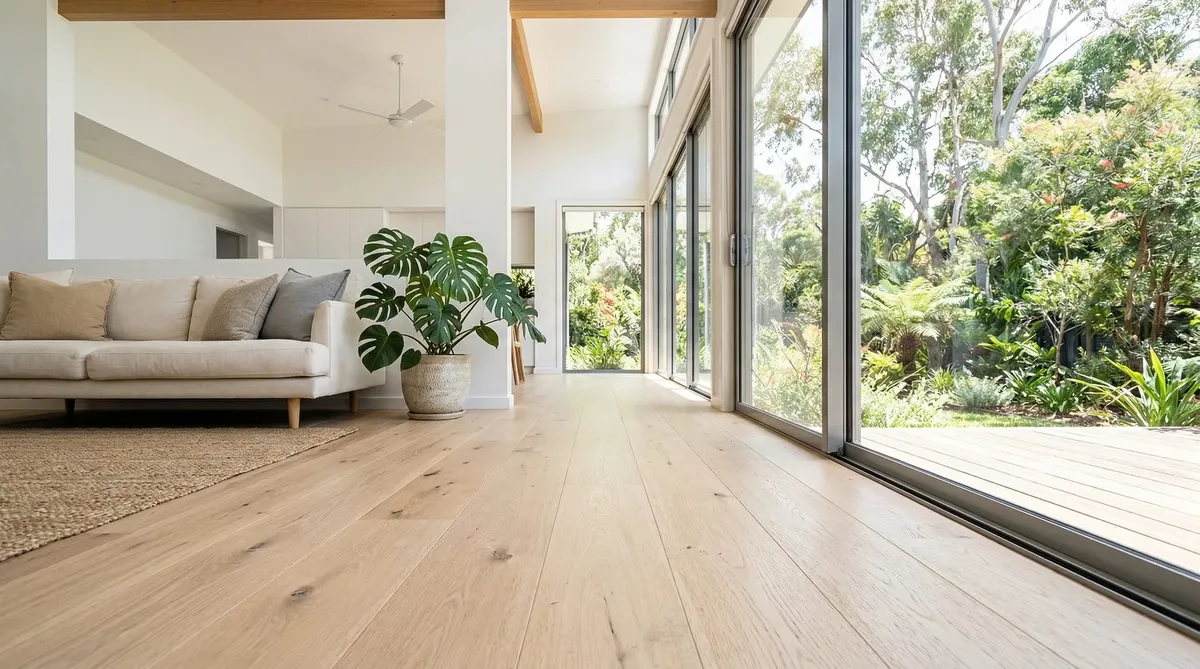
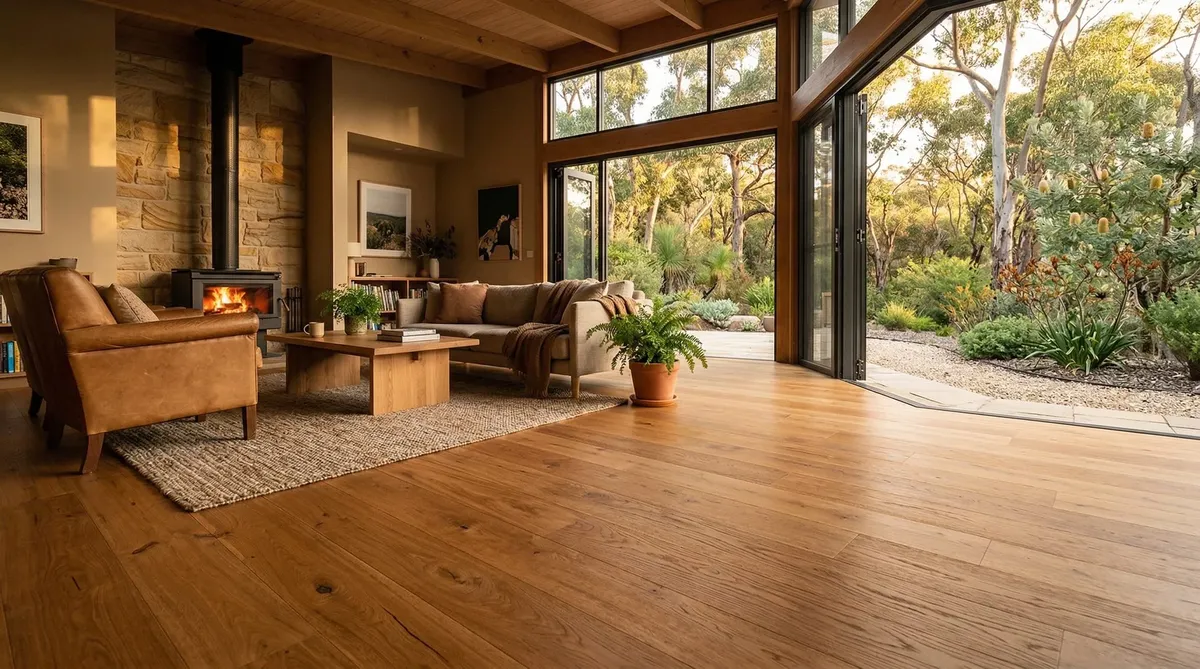
There is no single decision in an interior project that carries more weight — literally and figuratively — than the choice of flooring. The floor is the canvas upon which every other design decision is made. Cabinetry colours are selected against it. Furniture proportions are calibrated to it. Natural light bounces from it or is absorbed by it. Get it right, and the entire home coheres. Get it wrong, and no amount of beautiful furniture or considered lighting will rescue the result.
Choosing a hardwood floor, in particular, is an exercise in understanding timber as a living material: its origins, its character, its behaviour across seasons, and — perhaps most importantly — how it will age alongside you. This guide is designed to move beyond the showroom and give you the knowledge to make a decision you will still feel confident about in twenty years’ time.
Understanding the Species Palette
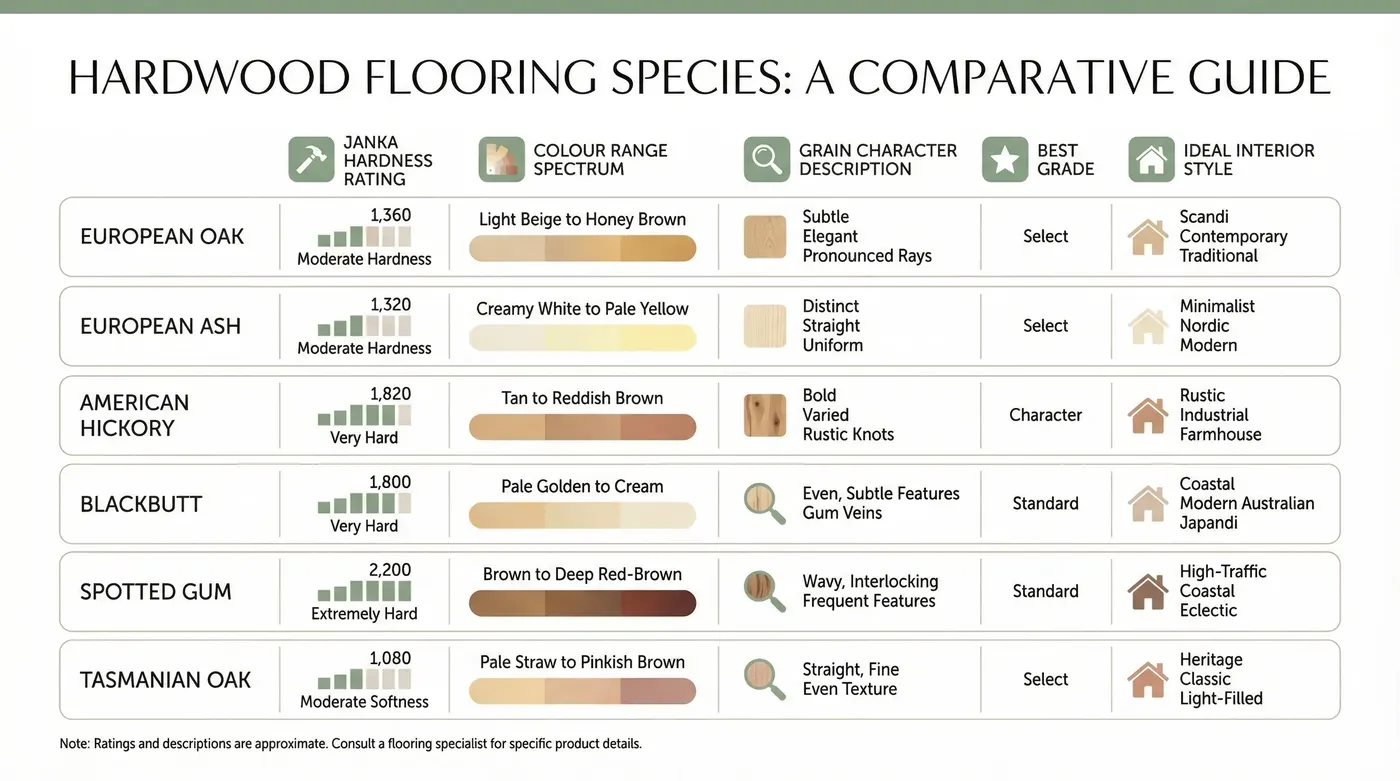
The first decision is species, and it sets the tone for everything else. Different timbers carry fundamentally different visual languages, structural properties, and suitability for the Australian climate.
European Oak
European Oak — sourced predominantly from the managed forests of France and Germany — has become the defining timber of contemporary Australian interiors, and for good reason. Its Janka hardness rating sits comfortably in the mid-range, making it hard enough to withstand household traffic while remaining workable for precision milling. More importantly, its grain structure is fine and consistent, with subtle medullary rays that catch light in a way few other species can replicate.
Visually, European Oak reads as quiet luxury. Its tonal range spans from the palest platinum-blondes through honey ambers to deep smoked charcoals, depending on the staining or brushing treatment applied. For contemporary interiors — those defined by clean lines, textural contrast, and a restrained palette — it is an almost universal solution. It sits with equal ease against white-oak cabinetry, dark walnut joinery, or polished concrete.
Certified product under EN 14342 (the European standard governing wood flooring characteristics, evaluation of conformity, and marking) gives you assurance that the timber’s performance — including formaldehyde emissions, slip resistance, and dimensional stability — meets independently verified benchmarks.
European Ash
Ash is frequently overlooked in favour of Oak, which is a mistake. Where Oak carries a certain visual weight, Ash is lighter and more open in character — its grain is pronounced and athletic, with a straight, almost architectural quality that suits interiors with a strong linear language. Ash works beautifully in spaces that pair it with white or off-white cabinetry and minimal ornamentation: Scandinavian-influenced design, coastal modernism, or pared-back transitional schemes.
Its natural tone is a pale warm beige, which takes staining predictably and evenly. If you want a floor that feels expansive, bright, and airy — particularly important in Melbourne’s lower-light winter months — Ash is worth serious consideration.
American Hickory
Hickory is the choice for those who want drama. With one of the highest Janka hardness ratings of the species commonly available in Australia, it offers outstanding durability — well-suited to households with large dogs, active families, or high-traffic areas that would compromise a softer species over time.
Its character is bold: pronounced grain variation, strong contrast between heartwood and sapwood, and a tonal range that moves from near-white to deep reddish-brown within a single board. This is not a background timber. Hickory demands to be the statement, which makes it ideal in Feature Grade for rustic, farmhouse, or industrial-influenced interiors where the floor is meant to hold visual attention rather than recede.
Australian Blackbutt
Blackbutt is one of the most trusted domestic hardwoods in the Australian construction and renovation market, and its reputation is well-earned. Grown along the eastern seaboard, it carries an inherent suitability for Australian conditions — its dimensional behaviour across humidity cycles is well understood and well managed.
Its appearance is clean and warm: a pale straw to light tan base with subtle pink undertones and a fine, relatively even grain. In Prime or Select Grade, it suits contemporary interiors that want a domestic, familiar warmth rather than the imported sophistication of European species.
Spotted Gum
Spotted Gum is, quite simply, one of the most visually striking timbers available anywhere in the world. Its interlocked grain creates a characteristic wavy figuring — the so-called "fiddleback" or "ribboning" effect — that changes appearance dramatically as viewing angles shift. Combined with a colour palette that moves from cream and pale brown through deep chocolate and olive-grey, Spotted Gum has an almost animate quality that no manufactured product can replicate.
It is also exceptionally hard — one of the hardest commercial flooring species available — and performs particularly well in areas of concentrated foot traffic. For a premium statement floor in a formal living room, master suite, or open-plan kitchen-dining area, Spotted Gum in Natural or Feature Grade produces a result that is genuinely singular.
Tasmanian Oak
Despite its name, Tasmanian Oak is not a single species but a collective marketing term for three related eucalypts — Eucalyptus delegatensis, E. obliqua, and E. regnans — harvested from the old-growth and regrowth forests of Tasmania and Victoria. The result is a timber with moderate hardness, a warm pinkish-honey colour palette, and a clean, straight grain that takes stains and finishes with excellent consistency.
Tasmanian Oak reads as warm and approachable — softer in character than Spotted Gum, more linear than Blackbutt. In Select or Natural Grade, it suits coastal and relaxed-contemporary interiors where the intention is to create a sense of welcoming comfort rather than precision.
Engineered vs Solid: The Structural Argument
Many clients arrive with a preference formed — solid timber, because "it feels more real." It is worth unpacking this assumption.
Engineered hardwood is constructed in layers: a top veneer of the chosen timber species (the face layer you see and walk on), with either a structural core layer of Hevea Brasiliensis hardwood, or a multiply core on many variants and then a stabilising base layer. The core material is notable — Hevea Brasiliensis carries the same density and structural strength as White Oak, meaning there is no compromise in the integrity of the product. Multiply is also highly regarded as a core, but professionals tend to favour the Hevea Brasiliensis due to synergy elements with the surface veneer. Importantly, the cross-grain orientation of either the single hardwood core or the multiply approach both create dimensional stability that solid timber, by its very nature, cannot match.
Wood is a hygroscopic material. It absorbs and releases moisture in response to the ambient humidity of its environment, expanding across the grain as moisture rises and contracting as it falls. In a solid timber floor, this movement is significant and must be managed through expansion gaps, careful acclimatisation, and ongoing humidity control. In an engineered floor, the cross-laminated core structure resists this movement, reducing the risk of cupping, gapping, and board separation — particularly relevant in the context of Australian homes with ducted heating and cooling systems that can drive humidity well outside the timber’s comfort zone.
For homes with hydronic underfloor heating, engineered is the only technically appropriate choice. The consistent radiant heat from beneath — which would induce severe drying and checking in a solid floor — is tolerated reliably by the engineered construction. It is worth noting that Australian species tends to not be recommended to be used in conjunction with underfloor heating and the only form of underfloor heating that is tolerated by the manufacturers of other species is hydronic, not electrical coil.
This is not to say solid timber has no place. In heritage or period properties, where solid boards are part of the architectural character, solid timber floors — particularly wider boards in a rustic grade — remain irreplaceable. The decision should be driven by the structural and environmental realities of the space, not sentiment.
Grades, Patterns, and the Language of Design
Choosing a Grade
The grade of timber — Prime, Select, Natural, or Feature — is arguably the single most impactful aesthetic decision you will make after species. Grade is not a quality ranking; it is a character statement.
Prime Grade is quiet and refined: consistent colour, minimal knots, almost no gum veins. It suits modern and minimal interiors where the floor is intended as a neutral ground.
Select Grade offers balance: a small degree of variation that adds warmth without visual complexity. The most versatile grade — it works across contemporary, transitional, and relaxed-modern aesthetics.
Natural Grade introduces genuine character: knots, gum veins, colour variation. It suits interiors that are supposed to feel lived-in, warm, and individual.
Feature Grade is bold and unapologetic: large knots, prominent gum veins, dramatic colour shifts. It is the choice for interiors with a strong conceptual direction — coastal, industrial, farmhouse, or maximalist.
Laying Patterns
The laying pattern is a design tool that is frequently underused.
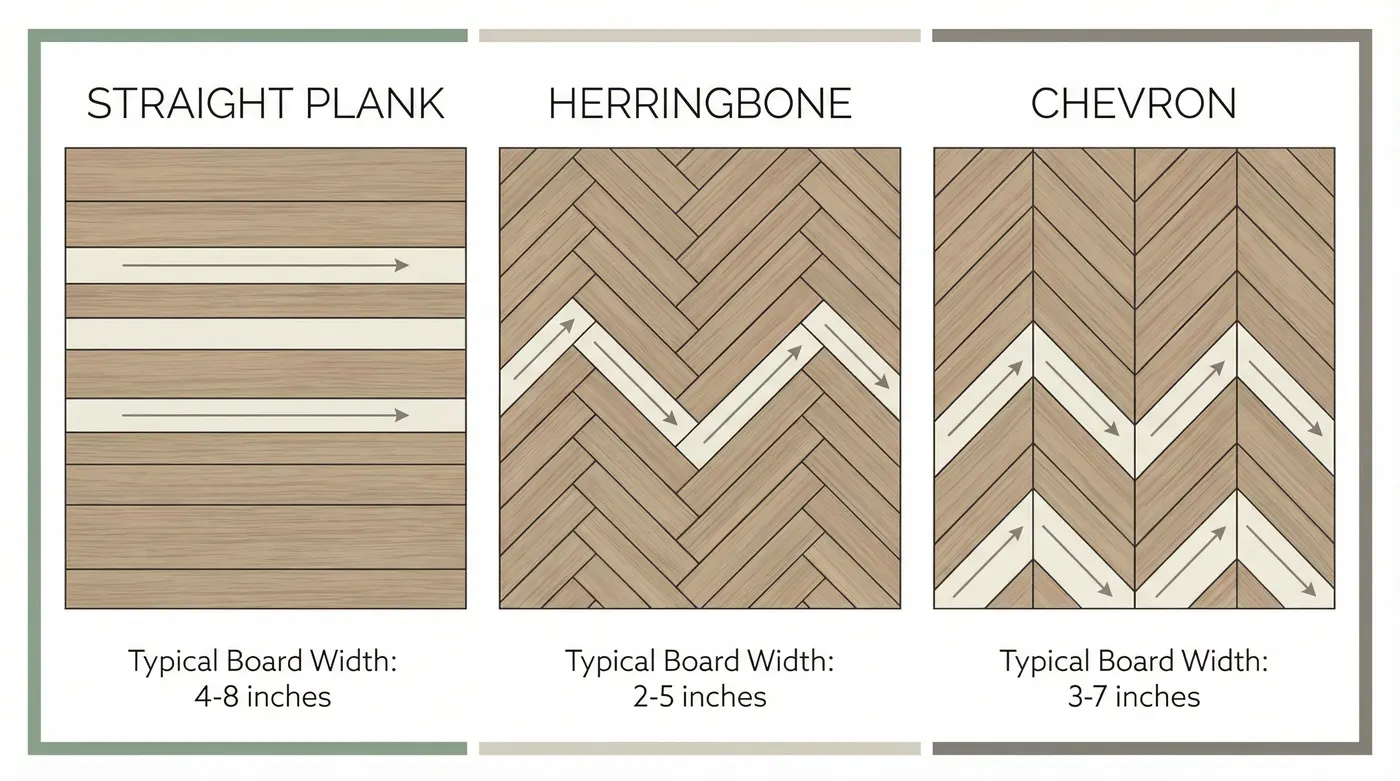
Straight plank — boards laid parallel in a single direction — is the default, and the correct choice for most spaces. It reads as calm and directional, with the grain lines emphasising length and drawing the eye through the room.
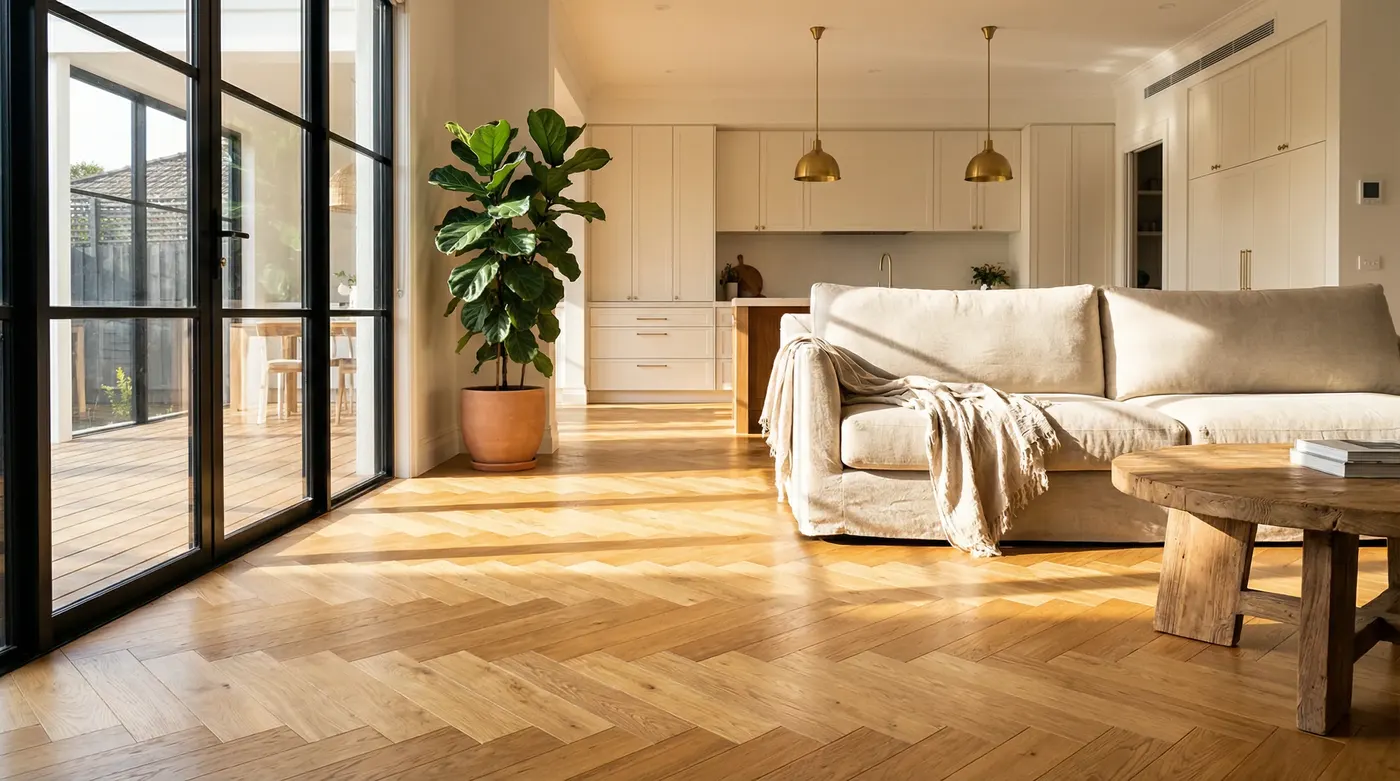
Herringbone — boards laid at 90-degree angles to one another in a V-pattern — is the oldest timber floor pattern in the architectural canon and currently experiencing a well-deserved resurgence. It adds visual complexity and a sense of craftsmanship that immediately elevates a space. It is a particularly strong choice in formal areas — entrance halls, dining rooms, studies — where a sense of ceremony is appropriate. Note that herringbone requires narrower boards (typically 90–130mm) to read correctly; wide planks in herringbone can feel ungainly.
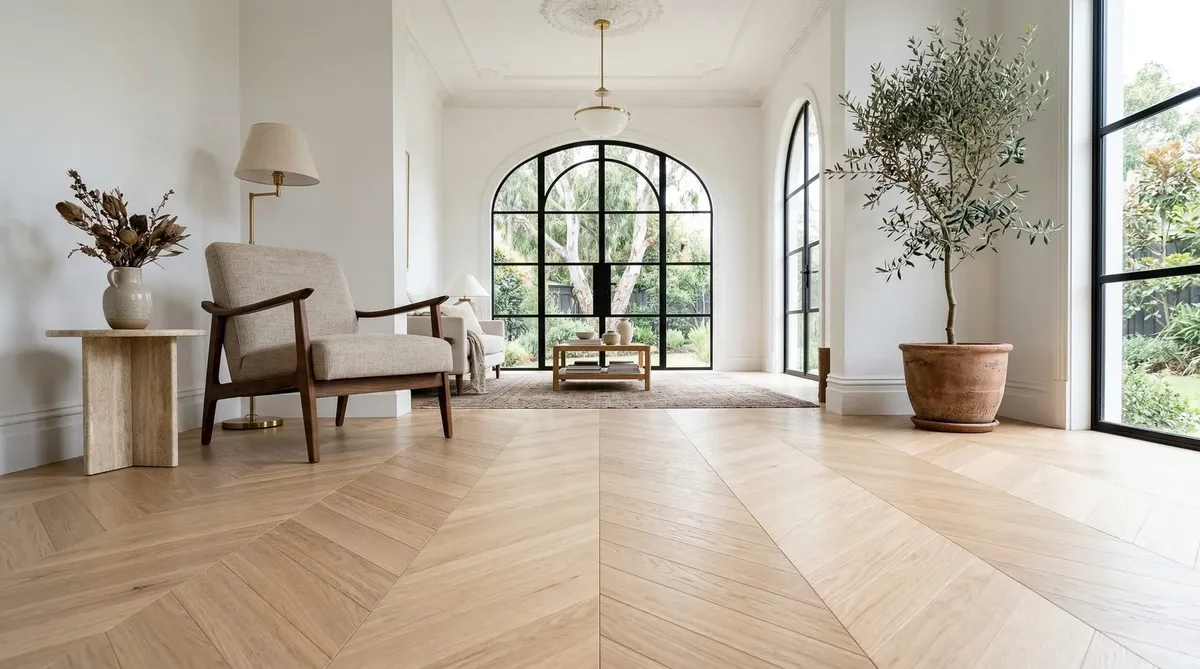
Chevron — a close relative of herringbone in which boards are cut at an angle and meet tip-to-tip — creates a more fluid, continuous movement through the floor. It has a slightly more contemporary sensibility than herringbone, and suits open-plan spaces where you want dynamic visual energy without the hard angles of the classic V.
Matching Floors with Cabinetry and Interior Schemes
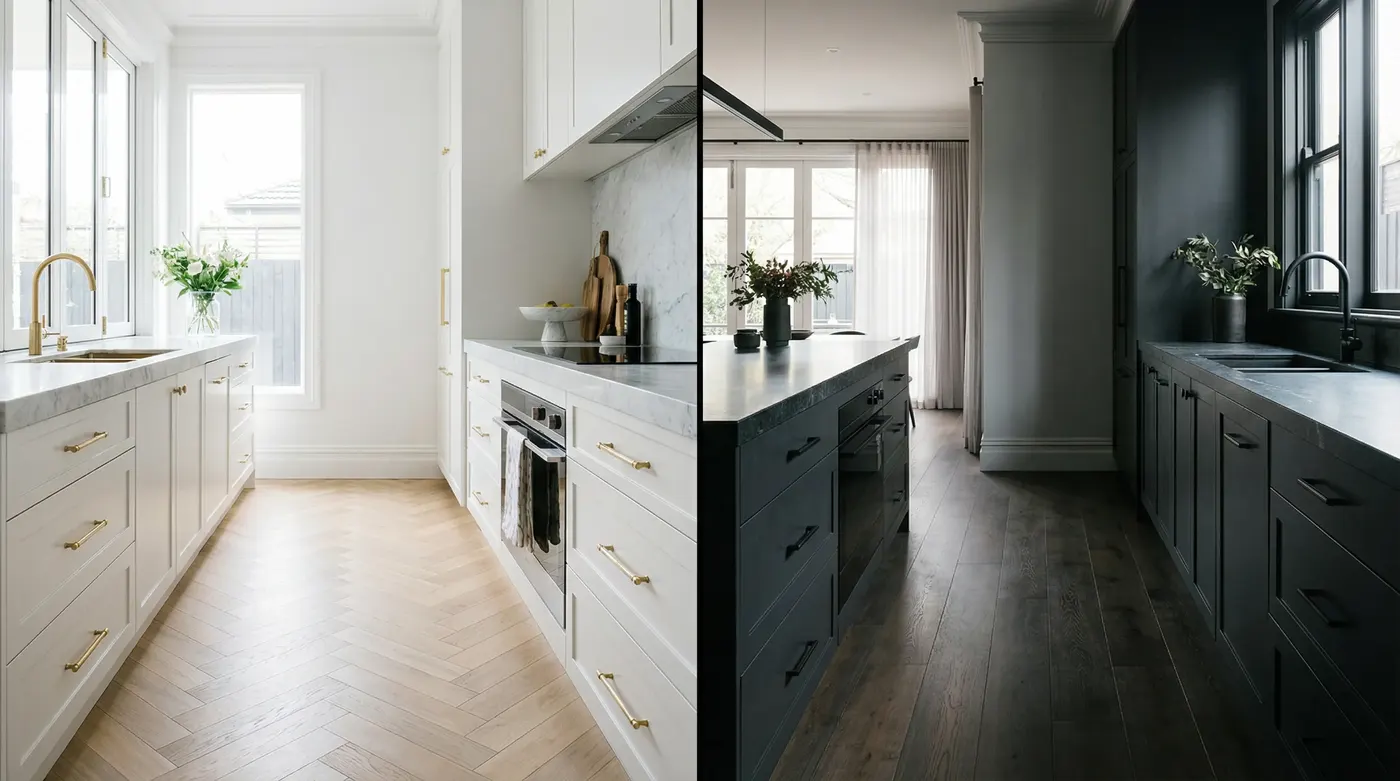
The relationship between floor and cabinetry is the central tonal tension in any interior. There are two reliable approaches: complementary harmony and deliberate contrast.
Complementary harmony means choosing floor and cabinetry tones from the same colour family — warm with warm, cool with cool. A pale European Oak floor with white or light-grey shaker cabinetry is the canonical example. The effect is calm, cohesive, and visually spacious. The risk is flatness — without contrast, an interior can feel without hierarchy.
Deliberate contrast uses tonal opposition to create depth and interest. A deep smoked Oak floor with light cabinetry allows each element to stand distinctly, with the floor anchoring the space and the cabinetry floating above it. Equally, a pale Ash floor with charcoal or forest-green cabinetry creates a graphic tension that reads as confident and contemporary.
One principle holds in either approach: undertone consistency matters above all. A warm-toned floor (one with yellow, amber, or red undertones) should pair with cabinetry that is similarly warm-toned — even if the cabinetry is white, that white should lean cream or warm rather than bright or cool. Mixing warm and cool undertones in the same plane produces a dissonance that is difficult to diagnose but immediately felt.
Room-Specific Considerations
Light Levels
Natural light transforms timber. In north-facing rooms that receive strong, consistent sun throughout the day, almost any species and grade reads well — light activates the grain and brings warmth to even the darkest floors. In south-facing rooms, which in Melbourne typically receive only indirect, cooler light for much of the year, pale species (Ash, Blackbutt, light European Oak) make a tangible difference to the perceived brightness of the space. Dark floors in south-facing rooms can read as heavy and oppressive unless very deliberately handled with well-designed artificial lighting.
Traffic Levels
Entry halls, main living areas, and kitchens require a species with a Janka hardness rating appropriate to the wear they will receive. American Hickory, Spotted Gum, and Blackbutt are the reliable choices for high-traffic zones. European Oak, while not soft, can show marks more readily in areas of concentrated foot traffic — which is often mitigated by choosing a brushed or textured surface finish that distributes fine scratches visually rather than highlighting them.
Denting versus Scratching
The ease of denting a floor is often reflective of the hardness rating or what is referred to as a Janka rating of the timber. It measures the propensity of the timber to dent when exposed to a dropped ball bearing. The higher the hardness, or Janka, the more pressure it requires to dent the timber. Scratches are not directly related to hardness, rather they will be related to the surface coating and mitigated by visual elements such as brushing and hand scraping that can be done during manufacturing to highlight the texture of the timber, assisting to hide scratches. Another element to consider is that scratches in the surface coating of a timber usually appear as a light colour, so choosing a floor colour that is dark will contrast the most with a scratch, making a scratch on a dark floor stand out more than the same scratch on a light-coloured floor.
Acoustic Performance
Wide-plank hardwood in open-plan spaces can amplify ambient noise — footfall in particular. For upper-floor installations, in some situations, an acoustic underlay is a functional requirement rather than an optional upgrade. The right underlay not only attenuates impact sound transfer but provides a degree of thermal insulation and protects the floor from moisture vapour rising from the subfloor. It should be noted that acoustic underlay restricts noise transfer to below areas, it is not designed to, nor will it, restrict reverberated sound in the area where the flooring is installed. Acoustic mitigation in the actual area where the floor is installed will be achieved by secondary furnishings such as curtains, rugs, furniture and so forth.
The Finish: UV Lacquer vs Oiled
Every engineered hardwood floor arrives with a factory-applied finish, and this choice affects both appearance and maintenance for the life of the floor.
UV lacquer creates a hard, sealed surface layer that sits above the timber. It is highly durable, resistant to liquid infiltration, and easy to maintain — routine cleaning with a pH-neutral cleaner is all that is required. The aesthetic is more uniform and contemporary, with a controlled sheen level (matt through to satin) that remains consistent over time. The UV component means it has been UV cured or hardened. It is not a reference to resistance to UV light later on.
With an Oiled floor, oil is applied and penetrates the timber fibres rather than forming a surface barrier, feeding the wood and enhancing its natural grain and texture from within. Oiled floors have a more organic, tactile quality — they look and feel closer to untreated timber. The trade-off is maintenance: periodic re-oiling (typically annually in high-traffic areas) is required to maintain the protection, however localised damage can be repaired in-situ without the need to sand back the entire floor.
Due to maintenance considerations, UV Cured Acrylic and Water Based Polyurethanes tend to be far more popular in Australia than oiled surfaces.
The choice between the two is ultimately an aesthetic and lifestyle decision. Lacquer suits those who want a floor that demands minimal ongoing commitment. Oil suits those who value the living, evolving character of timber and are willing to invest in its care.
A Final Word on Acclimatisation and Climate
Australia’s east coast climate presents specific challenges for timber flooring. Melbourne in particular experiences pronounced seasonal humidity swings — dry winters under ducted heating can push indoor relative humidity below 40%, while humid summer conditions can push it above 70%. These are challenging conditions for timber.
Proper acclimatisation before installation — allowing the boards to equilibrate with the ambient conditions of the space is important in situations where the humidity levels of the site where the floor is to be installed are different than those of where the product has been stored. Beyond installation, maintaining indoor relative humidity within the 45–65% range will protect the floor’s dimensional stability across years of use. A quality humidifier in rooms with active heating during winter is an investment that directly extends the life of your floor.
A hardwood floor is not a commodity purchase. It is a material decision that will define the experience of your home for decades. Made thoughtfully, with attention to species character, grade, pattern, and the specific demands of your space, it is also one of the most deeply rewarding design decisions you will make.
The Flooring Centre — Melbourne’s premium timber flooring specialists. Visit our Nunawading or Hawthorn showrooms to view the full species and grade range.
Published by The Flooring Centre — Melbourne's premium carpet and flooring superstores. Visit our Nunawading and Hawthorn showrooms.