By The Flooring Centre Technical Team
Why the construction science behind modern engineered hardwood makes it the professional’s choice for contemporary Australian homes — and why the old hierarchy no longer holds.
The question surfaces in almost every flooring consultation: “Is solid hardwood better than engineered?” It is a reasonable thing to wonder. Solid timber carries a deeply intuitive appeal — the sense that a single piece of wood, cut cleanly from a log, is somehow more honest, more durable, more real than its engineered counterpart. But this intuition, however understandable, is not supported by the construction science. In the conditions that characterise most Australian homes — concrete slab subfloors, underfloor heating, the dramatic humidity swings of a Melbourne summer-to-winter transition — engineered hardwood does not merely match solid timber. It performs substantially better.
Understanding why requires a close examination of how each product is actually built.
The Construction of Solid Hardwood: Strengths and Fundamental Limitations
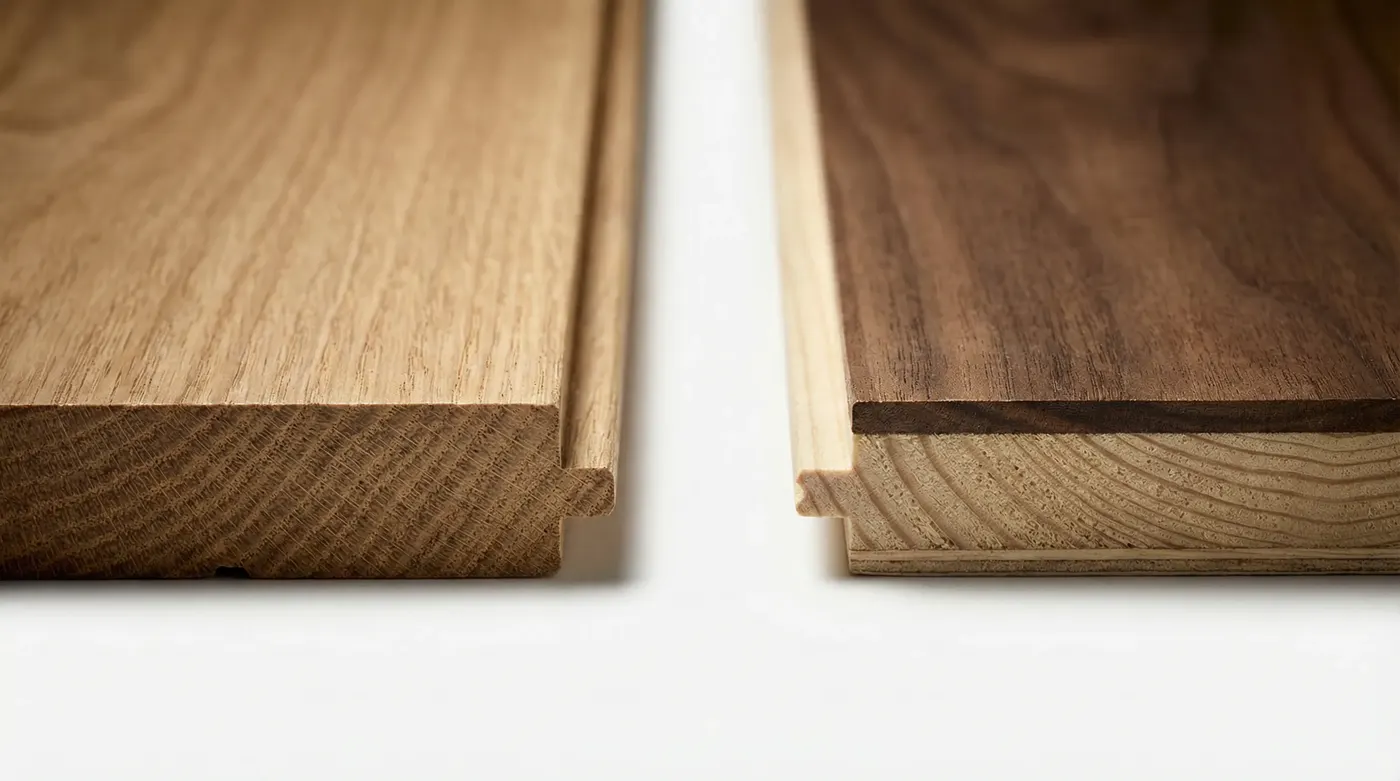
Solid hardwood is precisely what the name describes: a single piece of timber, milled to a consistent thickness — typically 19mm to 21mm for residential-grade boards — and finished with either a UV lacquer or UV oil. There is no composite, no lamination, no engineered substrate. The entire board, from the surface you walk on to the tongue-and-groove profile beneath, is one species, one piece.
This construction has genuine virtues. A solid board can be sanded and refinished multiple times over its life — potentially five or six full resands, depending on thickness and how aggressively each sanding removes material. Over a 50-year timeframe in a stable environment, a solid hardwood floor maintained properly can look magnificent and still have serviceable life remaining.
The operative phrase is stable environment.
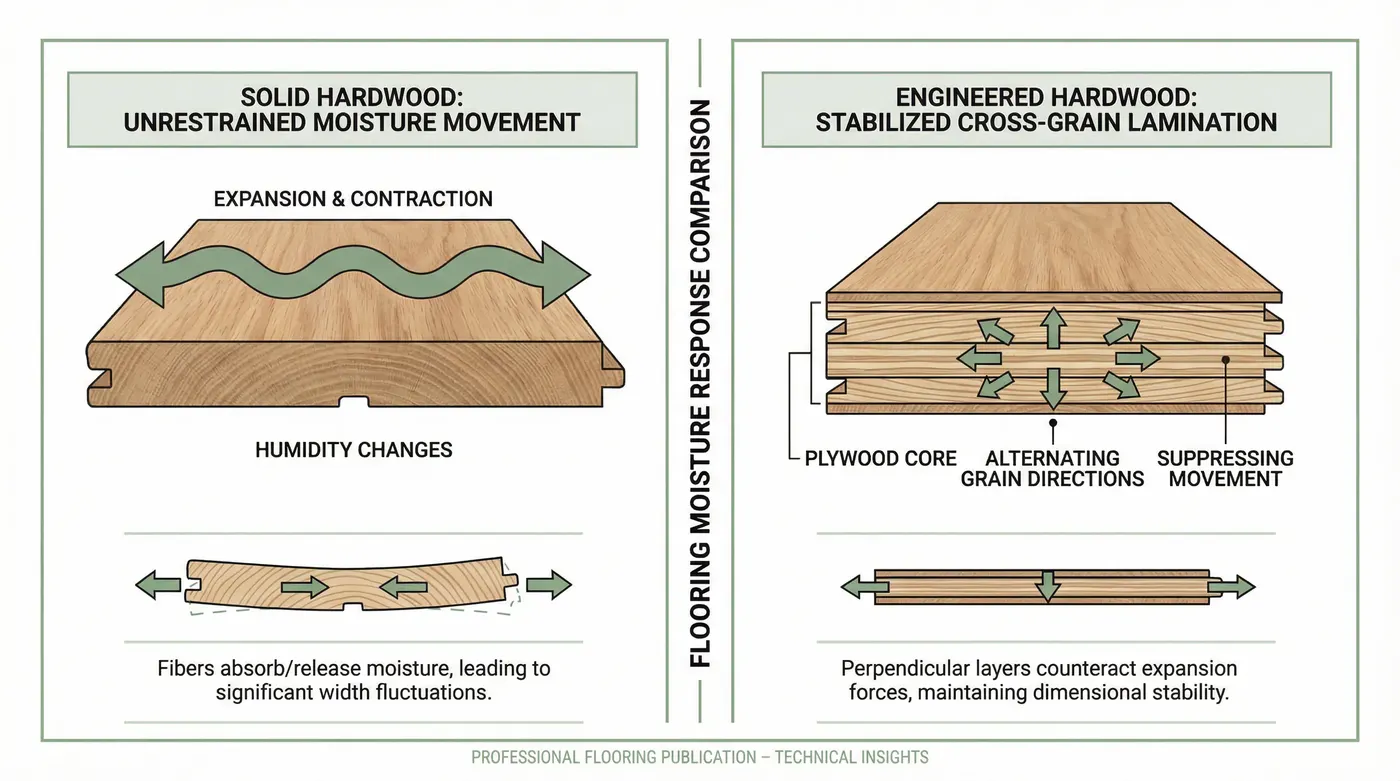
Wood is a hygroscopic material. It responds continuously to changes in ambient moisture and temperature, absorbing moisture when humidity rises and releasing it when conditions dry out. This movement — expansion and contraction across the grain — is the fundamental physical characteristic that constrains where and how solid hardwood can be installed.
Where Solid Hardwood Cannot Go
Concrete slab subfloors: The most common subfloor type in Australian residential construction. Slabs retain and emit residual moisture at levels incompatible with solid hardwood installation. Even after months of curing, a concrete slab typically maintains a moisture vapour emission rate that would cause solid timber to cup, bow, or buckle if direct-bonded or floated directly over it.
Over underfloor hydronic heating: The heat cycling required for radiant floor heating systems creates exactly the cyclical moisture fluctuations that cause solid timber to move. Most solid hardwood manufacturers will not warrant their products over underfloor heating.
Wide board formats: As board width increases, the potential for movement increases proportionally. Boards wider than approximately 120mm in solid timber carry meaningful risk of gapping in dry conditions and crowning in humid conditions. The contemporary preference for wide planks — 180mm, 220mm, 260mm and beyond — is simply not achievable in solid form in most Australian installation contexts.
The Engineering Behind Engineered Hardwood: Construction Layers Explained
Engineered hardwood is not a compromise product. It is an engineered system — designed from the substrate up to deliver the visual authenticity of solid timber while correcting the dimensional instability that makes solid timber problematic in modern construction.
The standard construction is a three-layer system or a multiply system:
Layer 1: The Wear Veneer (Top)
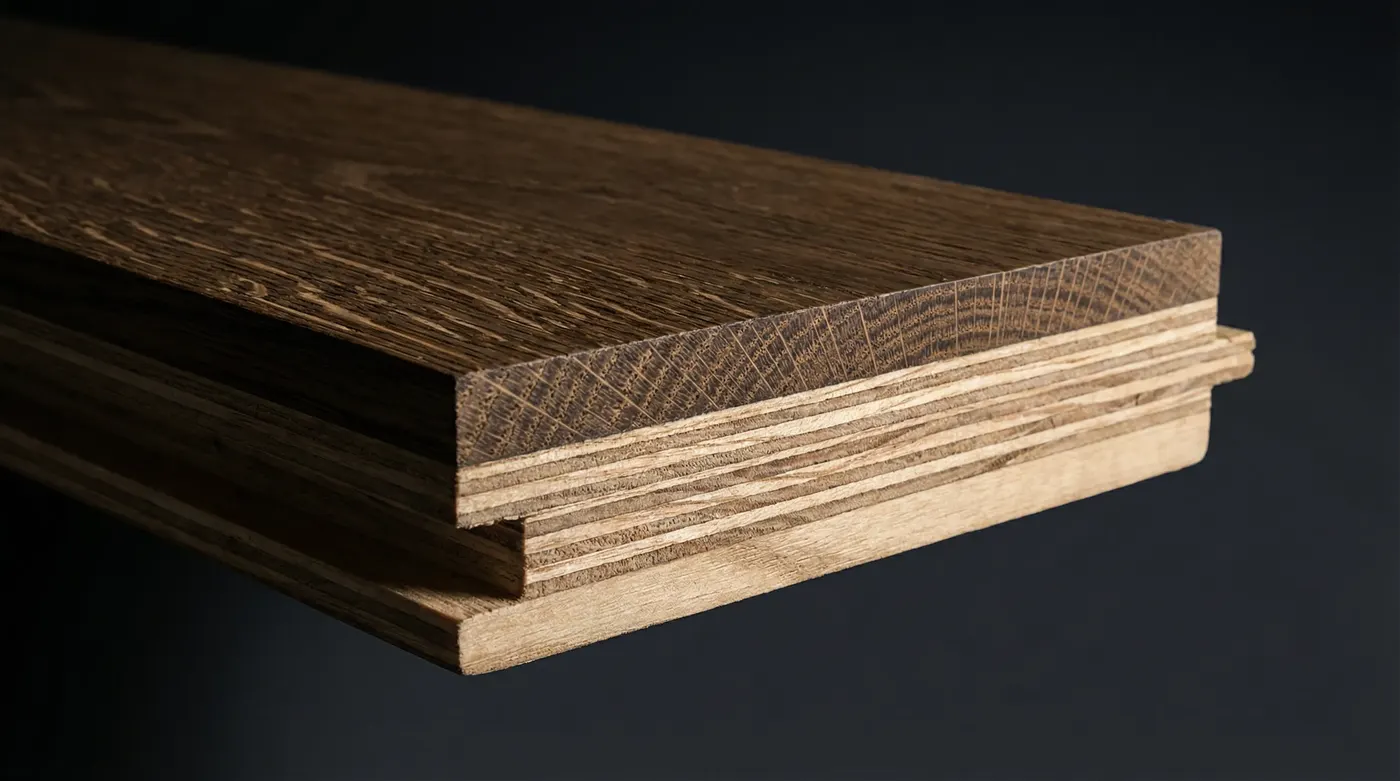
The top layer is a genuine timber veneer of the chosen species — European Oak, American Hickory, Australian Spotted Gum, and so on. This is real timber, not a photographic print or embossed simulation. The veneer is sliced or sawn from premium logs to the specification that determines refinishing potential:
- 2mm veneer: Allows one or two light sands over the floor’s life
- 3mm veneer: Allows two to three sands — the most common specification for quality residential products
- 4mm veneer: Allows three or more sands, approaching the refinishing potential of thinner solid boards
The species visible at the surface, the grade, the colour, the grain character — all of this is determined by the veneer layer. The floor looks and feels exactly like solid hardwood underfoot.
Layer 2 Variant: Hardwood Core (Hevea Brasiliensis)
This core layer is typically manufactured from Hevea Brasiliensis — plantation rubber wood sourced primarily from Indonesian and Malaysian sustainable forestry programmes. Hevea Brasiliensis is selected for this application because its density and mechanical properties closely match those of European White Oak, providing a core that is both stable and responsive to adhesive bonding.
The core boards are oriented at 90 degrees to the surface veneer — the cross-grain lamination principle. This is the structural key to why engineered hardwood performs so differently from solid timber. When moisture causes the surface veneer to want to expand laterally, the perpendicular core layer resists that movement. The opposing grain orientations cancel each other’s tendency to move, producing a board with dramatically lower coefficient of thermal and hygroscopic expansion.
Layer 2 Variant: Multiply Core (Various Species)
For multiply core constructions — where the core layer is itself composed of multiple thin cross-grain sheets of timber, all running in different directions. The species used depends on the positioning of the product. Birch is regarded as a gold standard, with Eucalyptus being a more cost-effective choice for manufacturers. The more plies the more stable the product is when it comes to multiply.
Layer 3: The Backing Layer (Base)
The bottom layer of the sandwich is a stabilising backing board — typically a medium-density hardwood substrate — oriented to balance the tension from the surface veneer. This balancing layer prevents cupping (the board curving across its width) and contributes to the overall flatness of the product.
The assembled product typically measures 14mm to 21mm in total thickness. The EN 13489:2023 standard (Multi-layer parquet and wood flooring elements) governs dimensional tolerances, moisture content at manufacture, bonding strength between layers, and surface coating performance for engineered products. Compliance with EN 13489 is the benchmark for quality in the engineered hardwood category.
Why Engineered Hardwood Dominates Australian Installations
The Australian residential construction landscape is dominated by concrete slab construction — the reverse brick veneer, the modern townhouse, the apartment, the knockdown-rebuild on a post-war block. Unlike the timber subfloor systems common in North American and Northern European homes, where solid hardwood originated and where it performs well, Australian slabs present a fundamentally different installation substrate.
The compatibility of engineered hardwood with concrete slab is not incidental — it is the primary reason the category accounts for the majority of premium hardwood flooring installed in Australia today.
Installation Methods
Direct Stick is the most structurally sound installation method for engineered hardwood. The boards are fully adhered to the concrete substrate using a flexible flooring adhesive. This method eliminates movement between the floor and the slab, produces the most solid underfoot feel, and is the best method suitable for wide boards over 190mm. A correctly direct-stuck engineered floor is effectively indistinguishable underfoot from a solid floor.
Floating Installation over an underlay without adhesive to the substrate. The boards are adhered to each other in a T&G constructed floor (the choice of professionals) or locked together with a clicking system (not recommended by professionals) and not fixed to the floor. Floating suits narrower boards (up to approximately 190mm) and is the method of choice for DIY or renovation projects where direct sticking is not practical or cost prohibitive. The reason professionals who float an engineered floor prefer a T&G (tongue and groove) profile is that by using a high grade PVACD3 adhesive, the boards are bonded together and this reduces squeaking and lateral movement when compared to the clicking profile that doesn’t use an adhesive.
Wide Board Formats: Only Achievable in Engineered
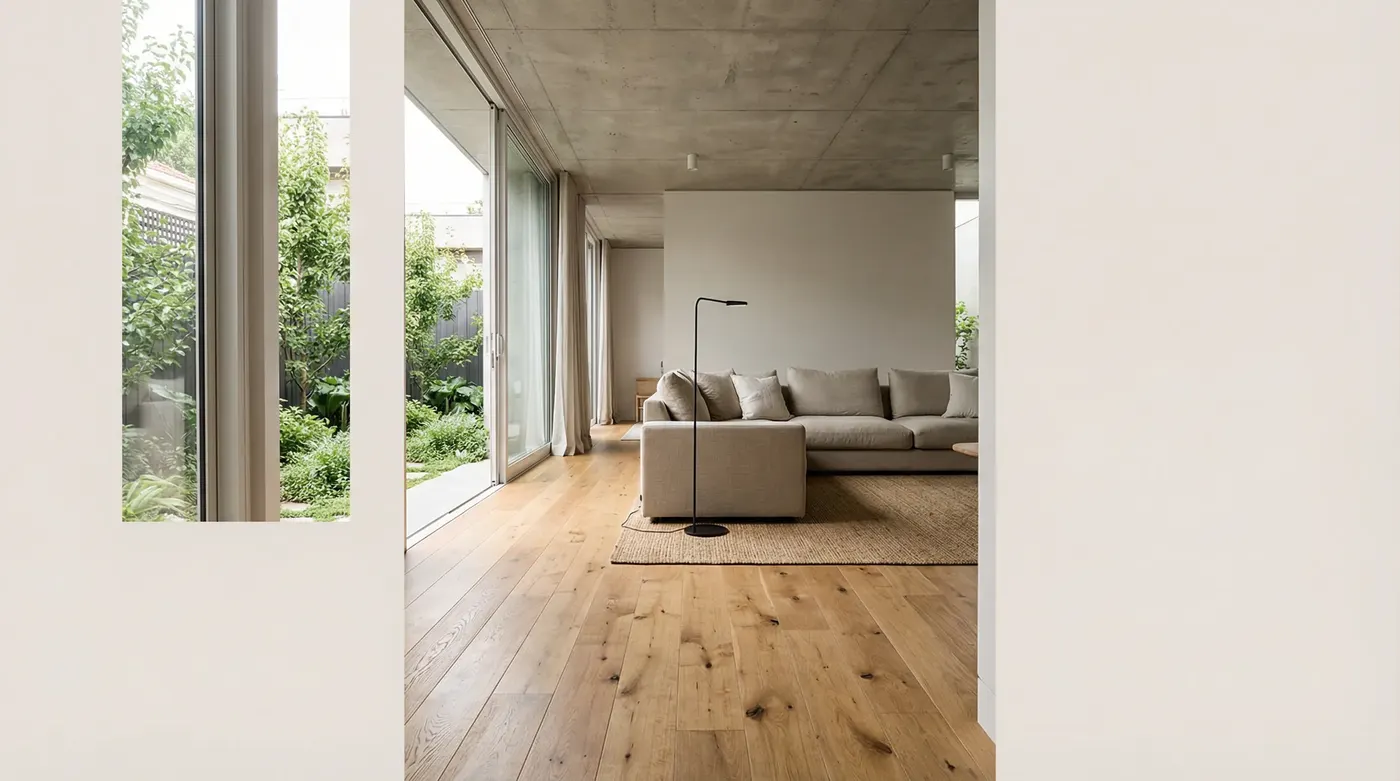
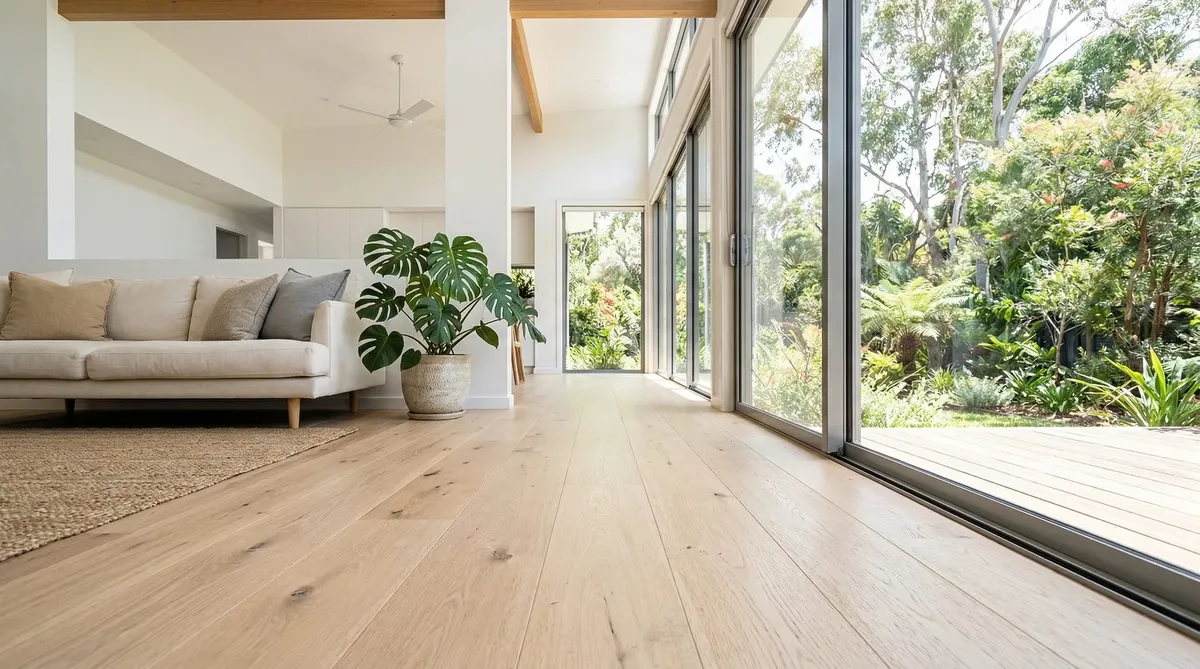
The dominant aesthetic trend in premium Australian interiors over the past decade has been the move to wide plank flooring — boards of 190mm, 220mm, 240mm, which produce a more expansive, contemporary visual result with fewer joins across a given floor area.
This format is only reliably achievable in engineered hardwood. The cross-grain lamination of the core layer suppresses the movement that makes wide-format solid boards problematic. A 240mm solid board in a Melbourne home would carry unacceptable risk of seasonal gapping in winter and crowning in summer. The same width in a quality multiply-core engineered product, direct-stuck to slab, performs without issue.
Underfloor Heating Compatibility
Hydronic underfloor heating is increasingly standard in Melbourne’s premium residential construction. It is one of the most comfortable and efficient heating systems available — and it is an application where engineered hardwood has a decisive advantage over solid.
The controlled, even heat distribution of a water-based radiant floor system is broadly compatible with engineered hardwood when installed correctly:
- The slab must be moisture tested prior to installation (using a calcium chloride or relative humidity probe test per AS/NZS 1080.1)
- The system should be commissioned — cycled up to operating temperature and back — before the floor is installed
- The operating temperature at the floor surface should not exceed 27°C
Under these conditions, most (not all) engineered hardwoods over hydronic heating are fully warranted installations. Solid hardwood in the same scenario is categorically not.
The Environmental Case for Engineered
The perception that solid hardwood is the more environmentally responsible choice is another area where the reality is more nuanced.
Consider the material efficiency: a 3mm-thick veneer sliced from a premium European Oak log can yield four to five times the floor area that the same log would produce in solid form. The cross-grained core uses Hevea Brasiliensis from plantation forestry — wood that is grown specifically for harvest and replaced continuously, rather than primary-growth forest species.
The net result is that a quality engineered hardwood floor delivers more floor area per tree harvested, with a lower proportion of premium old-growth timber per square metre. For specifiers who consider the chain of custody of their materials, this is a meaningful consideration.
Cost Comparison
Solid hardwood and engineered hardwood products occupy broadly overlapping price bands at the premium end of the market. A high-specification engineered European Oak with a 3mm veneer and hevea core will typically be priced comparably to mid-range solid Oak. At the top of the engineered range — wide planks, thick veneers, premium grades — engineered can actually command a premium over standard solid product, reflecting the additional manufacturing complexity.
Where engineered hardwood offers a clear cost advantage is in total installed cost:
- Direct-stick installation over concrete is straightforward and fast for an experienced installer
- Minimal subfloor remediation for moisture (which solid hardwood may require) thanks to the application of moisture barrier protection prior to adhesion
- Acclimatisation period far less than to the same extent as solid
- Lower long-term remediation risk from moisture-related movement
Because engineered hardwood is usually prefinished, there is no delay to waiting for sanding and sealing. The colours will normally be superior and local contaminants don’t have a chance to settle in the varnish.
Debunking the “Solid is Better” Myth
The belief that solid hardwood is inherently superior to engineered is a legacy of a period when engineered products were genuinely inferior — thin veneers over unstable cores, with poor bonding and inconsistent manufacture. That era is well behind us.
Contemporary engineered hardwood from reputable manufacturers — products built to EN 13489:2023 with certified cores, 3mm-plus veneers, and precision-milled profiles — is not a lesser version of solid hardwood. It is a different product that solves different problems. It is more stable, more versatile, more compatible with Australian construction, and in many contexts more durable over time.
The professional flooring consultant’s position is not “which is better?” but “which is right for this project?” — and for the vast majority of Australian homes, the answer is engineered.
The Flooring Centre stocks an extensive range of engineered hardwood — from 135mm traditional widths through to 240mm statement planks — in European Oak, Hickory, Spotted Gum, Blackbutt, and more. Visit our Nunawading or Hawthorn showrooms to review samples, discuss veneer thickness, and identify the specification that suits your project.
Published by The Flooring Centre — Melbourne's premium carpet and flooring superstores. Visit our Nunawading and Hawthorn showrooms.