By The Flooring Centre Technical Team
Australia’s love affair with open-plan living has never been stronger. From inner-city apartments to sprawling new-build developments in Melbourne’s growth corridors, the removal of internal walls to create fluid, connected living spaces has become the defining architectural characteristic of how Australians actually live. And yet, for all the spatial freedom this configuration offers, it introduces one of the most complex flooring challenges a designer or homeowner will face: how to create visual flow and coherent character across a single, undivided horizontal surface that must simultaneously serve as kitchen floor, dining room, living room, and increasingly, home office.
The floor in an open-plan home is not background. It is the single unifying design element in the most prominent space in the house, experienced in its entirety every time someone stands at the kitchen bench or sits in the living zone. Getting it right is a design achievement. Getting it wrong is very expensive to fix.
The Visual Psychology of an Open Floor
Before selecting a species, a colour, or a plank width, it is worth understanding what a floor is actually doing in an open-plan space.
In a compartmentalised home, each room’s floor is contained within walls. The viewer’s eye stops at the doorframe. In an open-plan configuration, the floor reads as a continuous plane — a visual field that the eye travels across uninterrupted. This has profound implications for how material choices register.
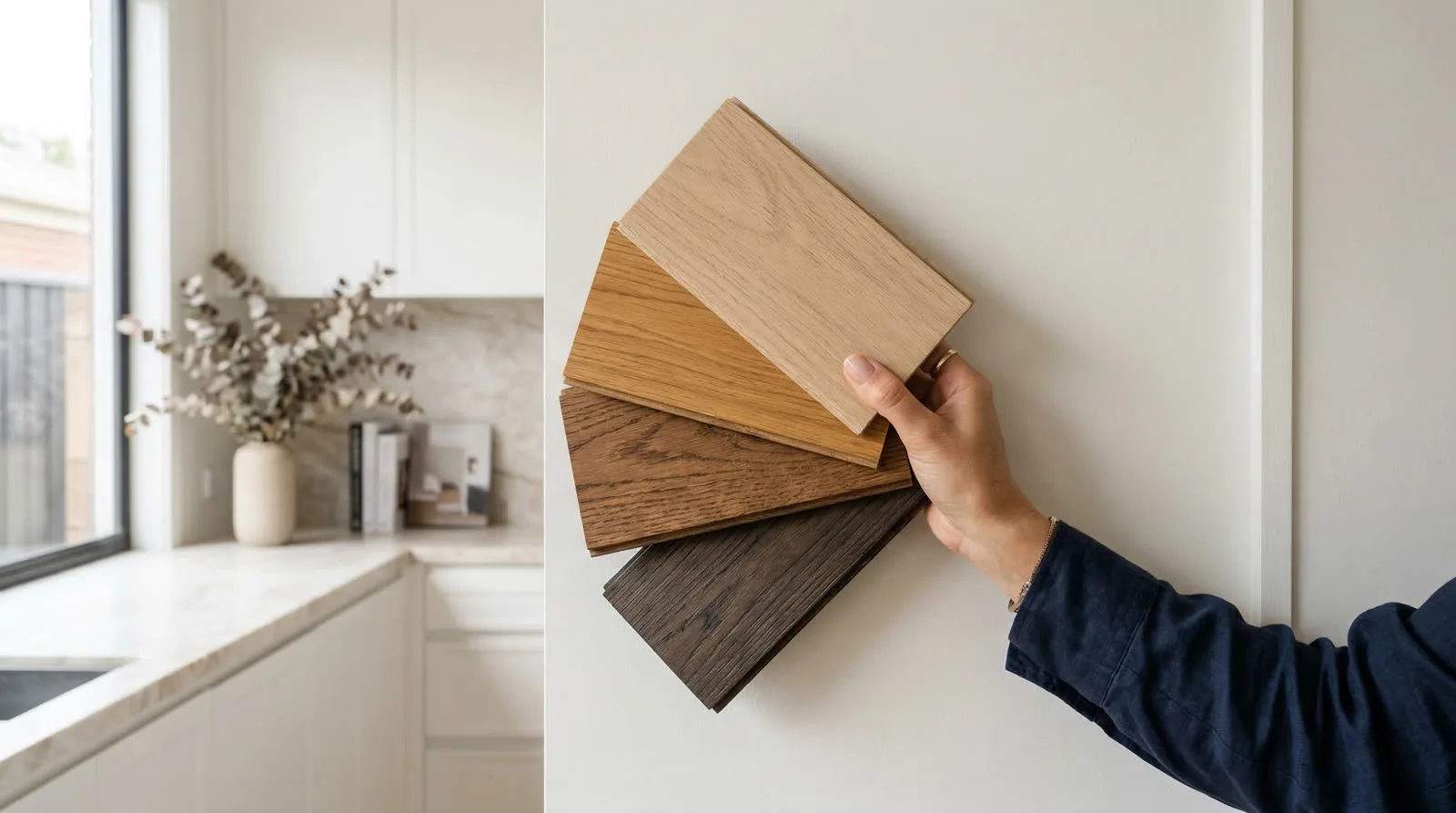
A floor that might look warm and inviting as a single plank in a showroom can read as busy and overwhelming when it runs 15 metres from the front door to the back glass wall. A floor that appears suitably dark on a small swatch can make an open-plan room feel smaller and more enclosed at full scale. Conversely, a pale, clean floor can make the same space feel airy and expansive beyond its actual square meterage.
The opening design principle for any open-plan floor selection is simple but frequently underestimated: think at scale, not at sample size.
Continuous Flooring: The Case for Visual Coherence
The strongest design move in an open-plan home is almost always to run a single flooring material continuously through the living, dining, and kitchen zones. This approach — preferred by architects, embraced by interior designers, and now expected by the premium residential market — creates a sense of spatial coherence and scale that is impossible to achieve with multiple materials meeting at arbitrary transition points.
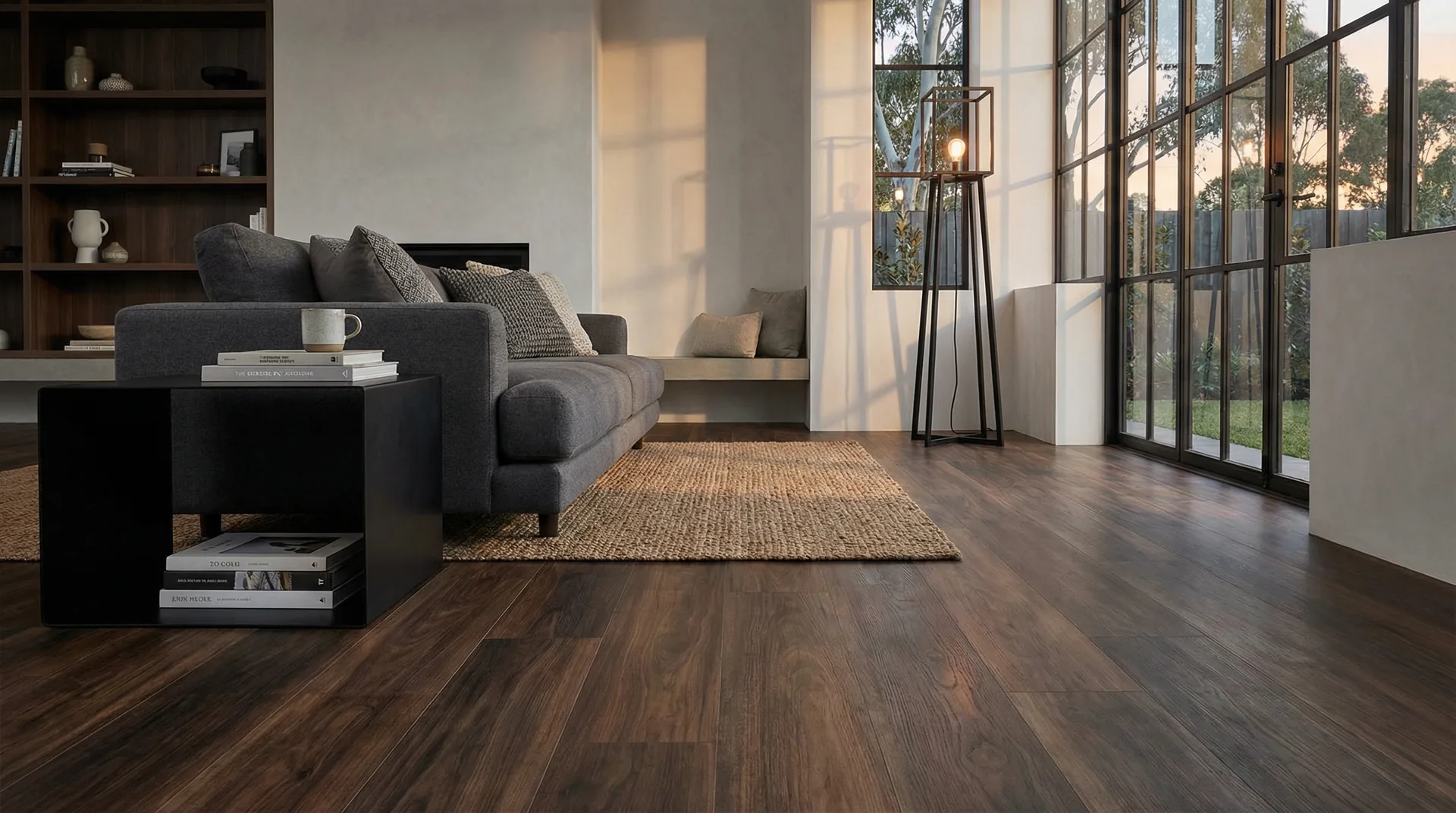
When a single engineered timber or premium water resistant laminate runs uninterrupted from the front hallway through to the kitchen and out to the alfresco, something important happens: the space reads as larger than it is. The eye is not arrested by transitions to other floor types. Instead, it follows the continuous surface to its natural boundaries — the walls — and reads the full depth and width of the home as a unified whole.
This is not merely aesthetics. Research in environmental psychology consistently shows that visual continuity in floor surfaces is one of the most significant contributors to perceived spaciousness in residential interiors. In the Melbourne market, where land prices ensure that even premium homes are working hard to justify their footprint, the spatial generosity created by a continuous floor is a legitimate design tool with measurable impact on how the home feels.
What “Continuous” Means in Practice
In a new build or full renovation, continuous flooring means ordering from the same production batch, using the same fixing method throughout, and ensuring the subfloor preparation is consistent across all zones. In a staged renovation — where only part of the ground floor is being renovated at a time — it means securing additional stock from the original batch for the subsequent stages, stored correctly to prevent moisture-related dimensional change.
Expansion limitations in design
Floating floors expand and contract. The longer the “run” or the larger the “raft” size, the more expansion that will be required. To address this, manufacturers limit the size of the permissible raft before they require an expansion profile fitted. This can be colour co-ordinated to the floor but often is not what the homeowner envisaged. Using an engineered board and fully adhering it to the subfloor is often the best visual outcome obtainable. Before you go down the path of choosing your floor and falling in love with a category or particular product, talk to an expert from The Flooring Centre so that the matter of internal expansion can be ticked off and you then look at the floor type that will provide the visual outcome you expect.
Plank Direction: The Unsung Design Decision
The direction in which planks are laid is one of the most powerful and least discussed flooring design tools available. In an open-plan setting, it deserves careful consideration rather than being left as an afterthought.
Laying planks parallel to the longest wall (or the primary entry axis) visually elongates the space, drawing the eye along the length of the room. This is the classic choice for terrace houses and townhouses, where depth is the spatial asset being maximised.
Laying planks perpendicular to the longest wall creates a sense of width — particularly useful in spaces that are deep but narrow.
Diagonal laying at 45° introduces a sense of dynamism and movement, and is particularly effective in large, square open-plan areas where neither the length nor the width is strongly dominant. It increases cutting waste by approximately 15%, and requires a higher degree of skill to execute cleanly at internal corners and doorways.
Herringbone and chevron patterns — both requiring a specialist installer — create a formal, architecturally confident statement in open-plan spaces. The herringbone pattern, in particular, has been a defining feature of Melbourne’s premium renovation market for the past decade, appearing in everything from South Yarra terrace restorations to Fitzroy warehouse conversions. At scale, the interlocking geometry of a herringbone floor creates an extraordinary sense of visual richness that no straight-lay floor can match.
Wide Planks and Spatial Perception
If plank direction is underappreciated, plank width is actively misunderstood by many clients entering the market. The intuitive assumption is that wider planks suit larger spaces and narrower planks suit smaller ones. The truth is more interesting.
Wide planks — 180mm to 260mm face width and above — actually make both large and small spaces feel more expansive, because they reduce the visual frequency of the join lines. Narrower planks create more linear texture; wider planks create a calmer, more continuous visual surface. In an open-plan setting where the floor is experienced across a long sight line, wide-format planks read as more relaxed and luxurious.
Premium European Oak engineered flooring in the 220–260mm face width range has become the reference specification for Melbourne’s higher end residential market — particularly in the new-build apartment and townhouse sector — for precisely this reason. The reduced joint frequency at scale creates a floor that feels intentional and considered, rather than one that arrived from a standard specification sheet.
The practical implication: for open-plan spaces over 60 square metres, a plank width under 150mm will often feel visually undersized, creating a busy appearance at scale that the space does not need.
Where to Transition Materials
While the case for continuous flooring is strong, there are moments in any open-plan home where material transitions are not only appropriate but essential.
The Bedroom Threshold
The single most common and defensible transition point is between the open-plan living area and the bedrooms. Bedrooms serve a fundamentally different function — rest, intimacy, warmth — and benefit from the acoustic softness, thermal comfort, and tactile luxury of carpet. A clean, well-detailed transition strip at the bedroom doorway, moving from engineered timber or water-resistant laminate in the living zone to wool or wool-blend carpet in the bedroom, is a design decision that improves both the aesthetic and the functional performance of the home.
The Alfresco Connection
Where an indoor-outdoor connection is a design priority — and in Melbourne’s lifestyle-focused residential market, it almost always is — the floor transition to an outdoor alfresco area requires particular thought. The goal is visual continuity without compromising performance. Exterior tiles in a tonal reference to the interior timber (similar undertone, comparable scale) are the most reliable approach: they offer the visual bridge between inside and outside while providing the slip resistance, UV stability, and weather tolerance that is required outdoors.
Some projects achieve spectacular continuity by using a related timber species in a treated hardwood decking format outdoors — Australian Blackbutt decking adjacent to Blackbutt engineered flooring indoors, for example — though the colour differential that develops over time as the exterior deck weathers must be factored into the design intent from the outset.
The Laundry and Bathroom
These remain non-negotiable transitions. Tiles are generally the appropriate choices for wet areas. The transition should be clean, well-detailed with a T-bar or threshold strip, and consistent in its treatment throughout the home. The reason tiles are still king in these areas is not just water related, but also for resistance to cleaning chemicals that can be used in these areas.
Acoustic Considerations: The Hard-Floor Challenge
One consequence of the open-plan, hard-floor home that is rarely discussed in the excitement of the design phase — and frequently raised with frustration in the months after installation — is acoustic reverberation.
A large, open-plan timber floor is acoustically unforgiving. Sound waves from conversation, kitchen activity, and entertainment systems reflect off the hard surface rather than being absorbed, creating a “live” acoustic environment that can feel noisy and fatiguing, particularly for families with children or for those who work from home in an adjacent zone.
The solutions are design tools in their own right:
- Rug layering is the most elegant and immediately effective strategy. A large rug — appropriately scaled to sit under the full footprint of the sofa and coffee table — introduces absorption at the point in the room where conversation is most dense. A 3m × 2m rug, or larger, is generally the minimum effective size in an open-plan living zone; smaller rugs are visually underscaled and acoustically negligible.
- Soft furnishings — upholstered sofas, curtains, cushions — contribute meaningfully to the acoustic performance of hard-floored spaces. Specifiers working on projects where acoustic quality is a priority should incorporate soft furnishing budgets alongside the flooring specification, not as an afterthought.
- Acoustic Wall Panels – a developing trend is to employ acoustic panels designed to absorb sound reverberation. They are available in all types of styles and even large canvas artworks that secretly do the job rather well in quietening down a room.
Kitchen-Specific Requirements
The kitchen zone in an open-plan home imposes material requirements that the living and dining zones do not. Continuous flooring is the design goal, but the substrate must be equal to the task.
Water Resistance: Splashes from the sink, steam from cooking, and incidental spills are constant in a kitchen environment. Engineered hardwood — by virtue of its dimensional stability and sealed surface — performs well in these spaces provided spills are removed promptly. However, even engineered timber has limitations: prolonged standing water at joins should be avoided, and the subfloor must be verified as level and dry before installation.
Durability: Kitchen floors experience heavy foot traffic and the specific abrasive load of sand and grit tracked in from outdoor areas. A UV-lacquered finish in a hardness of at least 3500N (Brinell hardness) — which corresponds to European Oak and harder — provides adequate protection. European Oak at 3.7 Brinell and Australian Blackbutt at approximately 9.1 Brinell (significantly harder) are both well-suited to kitchen environments.
Slip Resistance: While Australian Standard AS 4586 governs anti-slip classification for public areas, the domestic kitchen — particularly around the sink — benefits from a floor finish with at least a P3 rating in the immediate sink zone. Many engineered timber finishes meet P3, but this should be verified with the manufacturer for the specific product specified.
Colour Consistency Across Large Areas: Managing Batch Variation
One of the most overlooked technical challenges in large open-plan flooring projects is the management of colour consistency across the full area. Timber flooring is a natural product, and production batches — even from the same species, the same grade, and the same manufacturer — can exhibit subtle tonal shifts. This is not a product defect; it is an inherent characteristic of natural material production.
The practical implications:
- Order the entire project requirement from a single batch — confirm the batch number with your supplier before ordering, and request to inspect a range of boxes before committing
- Order a minimum 10% overage to cover cutting waste, future repairs, and the inevitable plank or two that needs to be set aside
- Store excess flooring in climate-controlled conditions at the same relative humidity as the installation environment (45–65% relative humidity, per manufacturer guidelines)
In extended open-plan spaces — homes where the floor runs from the front entrance through to a rear kitchen and beyond 20 linear metres — the difference between correctly matched and mismatched batches is visible and difficult to unsee.
Connecting Indoor and Outdoor: Alfresco Continuity in Melbourne Homes
Melbourne’s lifestyle culture — outdoor entertaining, the alfresco extension of the kitchen and living zone — means that the visual relationship between the interior floor and the outdoor alfresco is a design consideration that deserves strategic thought in most projects.
The ambition is a visual connection between inside and outside that makes the total living space feel larger and more fluid. The practical challenge is that the materials that perform beautifully indoors (engineered timber, water resistant laminate etc) and the materials that perform outdoors (porcelain, natural stone, hardwood decking) are not the same materials.
The most successful approach — used repeatedly by Melbourne’s leading residential designers — is to select outdoor materials that reference rather than match the interior floor:
- If the interior floor is warm-toned European Oak, select an outdoor porcelain in a similar warm beige-to-honey palette and comparable scale
- If the interior floor is a mid-brown Blackbutt, a Blackbutt or Spotted Gum hardwood deck in the same tonal family creates a seamless visual bridge even though the material changes
- The grout line in outdoor porcelain should reference the join line in the indoor timber wherever possible — keeping scale consistent reinforces the connection
Melbourne’s Floorplans: From Victorian Terrace to New Development
Melbourne’s residential building stock presents a uniquely diverse range of floorplan challenges for open-plan flooring specification.
Victorian-era and Edwardian terraces (largely in inner suburbs: Carlton, Fitzroy, South Yarra, Northcote) typically feature a narrow central corridor — often original Baltic pine boards — opening into a rear extension that is the open-plan living zone. The design challenge is the transition between a heritage-style original floor and the contemporary open-plan extension. Common solutions include polishing and matching the original boards, installing engineered boards in a consistent species, or making a deliberate material break at the point where old meets new — a celebrated distinction rather than a clumsy junction.
Medium-density townhouses and terraces (increasingly common throughout Melbourne’s middle ring suburbs) feature uniform subfloors and benefit from a clean, continuous specification across all ground-floor living zones. Wide-plank engineered oak is the premium default specification for this typology.
New apartment developments bring acoustic requirements to the fore, as floor-to-ceiling heights are often modest and impact sound transmission is a genuine concern for both residents and body corporates. Acoustic underlay is non-negotiable; water resistant laminates or hybrid flooring is increasingly specified by developers as the base standard.
Large suburban family homes (the 500+ square metre homes of Melbourne’s outer premium ring and bayside suburbs) have the luxury of genuine scale. Wide-plank, Feature grade timber in large open-plan zones; Select or Natural grade in formal living rooms; wool carpet in all bedrooms. This is the full material palette of the premium Melbourne family home, and when executed well, it is one of the most architecturally coherent residential interiors available anywhere.
The Design Principle to Hold
Open-plan flooring is not one decision — it is a sequence of interconnected decisions about flow, scale, transition, acoustic performance, and material suitability. The designer or homeowner who considers these dimensions together, before a single board is ordered, will achieve a result that elevates the architecture rather than merely covering the subfloor.
The floor is the one surface that every occupant is in physical contact with every time they enter the space. It deserves — and invariably rewards — the time invested in getting it exactly right.
Published by The Flooring Centre — Melbourne's premium carpet and flooring superstores. Visit our Nunawading and Hawthorn showrooms.